
Vienna to Budapest by Bike: A Danube Guide for 2027
Seven riding days, three capitals and a choice of riverbanks. A practical guide to the route, the ferries and what a one-way trip actually costs.
At Vác, a day’s ride from Budapest, two cyclists can stand at the same ferry landing with perfectly good maps and different plans. One is crossing towards Szentendre for lunch and a ride into Buda. The other is staying on the eastern bank and heading for Pest. Both are riding from Vienna to Budapest. Only one needs the ferry to be running that morning.
That little decision explains why the trip begins at home with a map. The Danube gives the journey its direction, but it rarely dictates a single road. Sometimes you ride beside the water for kilometres. Sometimes the good cycling is inland among the villages. At Komárom, even the choice of a hotel can put you in a different country for the night.
For a first independent trip I would set aside seven days on the bikes and eight nights away, arriving in Vienna the evening before and sleeping in Budapest after the finish. Allow roughly 350 km for the version below, then measure the route between the hotels you actually book. For four adults sharing two rooms, the worked budget comes to €1,129 per rider, or about €1,241 with a 10% reserve, before travel to Vienna. A couple can ride exactly the same stages, but will split the bike collection fee two ways.

How far is it, and why do the published figures differ?
Start with the European Cyclists’ Federation’s Vienna–Budapest map. It provides both the whole EuroVelo 6 track and a download of the developed sections. On the international map, a line can include stretches at different stages of development. Zoom in before taking it to mean a protected, surfaced cycleway. EuroVelo route map and GPX downloads
Then read the fine print on any mileage you borrow. Eurobike, for example, describes an eight-day holiday with around 320 cycling kilometres. The first and last days are arrival and departure, and its itinerary uses a boat or train for part of the approach to Budapest. That is a sensible holiday, but its total answers a different question from “How far will we pedal to our hotel?” Eurobike’s day-by-day itinerary
The figures below are planning allowances, rounded for a tour through Győr and the Danube Bend. Your total changes with the bank, the bridge, any ferry and the distance to your bed. On this itinerary every stage ends in the next overnight town by bike, apart from any short river crossing you choose. There is no scheduled train or sightseeing boat to complete the distance.
| Riding day | From → to | Allow around | Why stop here |
|---|---|---|---|
| 1 | Vienna → Bratislava via Hainburg | 65–80 km | First capital-to-capital stage. Allow time to leave Vienna and find the hotel on arrival. |
| 2 | Bratislava → Mosonmagyaróvár via Rajka | 40–50 km | A shorter day leaves a morning in Bratislava and an unhurried first evening in Hungary. |
| 3 | Mosonmagyaróvár → Győr via Hédervár | 40–50 km | An afternoon in Győr is worth more than pushing on to the next town. |
| 4 | Győr → Komárom | 40–55 km | A relatively short stage, with a choice of sleeping on the Hungarian or Slovak bank. |
| 5 | Komárom → Esztergom | 55–65 km | The basilica and the bridge to Štúrovo make a natural end to the day. |
| 6 | Esztergom → Vác via Szob and Nagymaros | 50–65 km | Give the Danube Bend its own day, with time for viewpoints and crossings. |
| 7 | Vác → Budapest | 40–60 km | Choose the direct eastern approach or the ferry and Szentendre option. |
Can you do it in five days? At a planning distance of 350 km, five days means averaging 70 km, six means about 58 km and seven means 50 km. That sounds like a small difference until someone wants a morning at the basilica. At 16 km/h while moving, 70 km takes nearly four and a half hours of pedalling. Add breakfast, finding the route, lunch, photographs and a puncture, and the entire daylight schedule looks different. For a fit group, five days is reasonable. For a first trip with luggage, seven is the version I would book. For children or riders new to touring, first try two consecutive days at home with the distances, loads and surfaces you expect abroad.
The ride, west to east
1. Vienna to Bratislava: leave the city on the right track
Agree on the actual start pin before measuring the first leg. A hotel in central Vienna, a handover by the Danube and a start at the eastern edge of the city all produce different totals. From the city, the Danube cycling network leads towards the Lobau and the floodplains of the Donau-Auen. Hainburg is a useful late-stage stop before the approach to Bratislava. If you want the Roman sites around Carnuntum, plot the detour and its crossing in advance. Although the sights are close on a map, they may be on the other side of the river. Vienna’s guide to the Danube cycle path
A floodplain is lovely riding country, and a poor place to discover that your only saved track is closed. Check local route notices before setting off. Carry enough water and a lunch option for the open stretches. In Bratislava, I’d head for the hotel first, lock the bikes and visit the old town on foot. It is easier to enjoy the evening when four sets of panniers are already indoors.

2–3. Bratislava to Győr: change currency and slow down
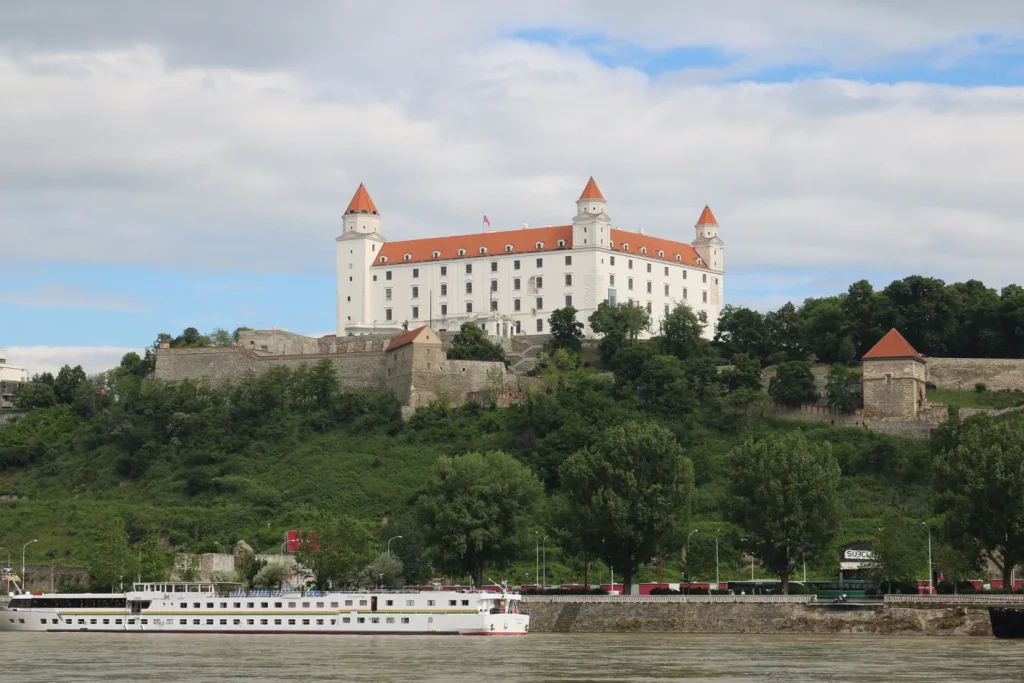
Beyond Bratislava the Hungarian option goes through Rajka into Szigetköz, a landscape of Danube branches, farmland and small settlements. Mosonmagyaróvár makes a good overnight stop precisely because it comes relatively early. It gives you the choice of lingering at breakfast in Bratislava or getting into Hungary with time to sort out supplies. Austria and Slovakia use the euro. In Hungary, keep some forints for small purchases and local crossings. Compare accommodation prices in the currency the host actually charges.
The next morning, Hédervár is a practical waypoint on the way to Győr. This is a day when being away from the main river can improve the trip: a village square, a shop for lunch and shade beside a side channel are more useful to a touring cyclist than an unbroken view of the embankment. In Győr, the baroque centre is a good reason to stop for the night. If you compress days two and three into one, count on about 80–100 km and decide in advance which town you want time to see.
4–5. Győr to Esztergom: two towns with almost the same name
Komárom is in Hungary. Komárno is in Slovakia. A bridge joins them. When a booking site presents both as nearby results, check the country, the street address and the approach to the hotel. A room across the river may suit your route perfectly. It becomes inconvenient only if you discover it after an evening meal with tired riders.
On the Hungarian route east from Komárom, the river corridor passes Szőny and Almásfüzitő. Near Dunaalmás and Süttő the Gerecse foothills begin to shape the landscape. This stretch has settlements and road sections as well as quieter riding. Fit a bike mirror if you use one at home and keep your group small enough to regroup comfortably at junctions. The route to Esztergom and the Hungarian stage downloads are available from the national EuroVelo site. Komárom–Esztergom stage
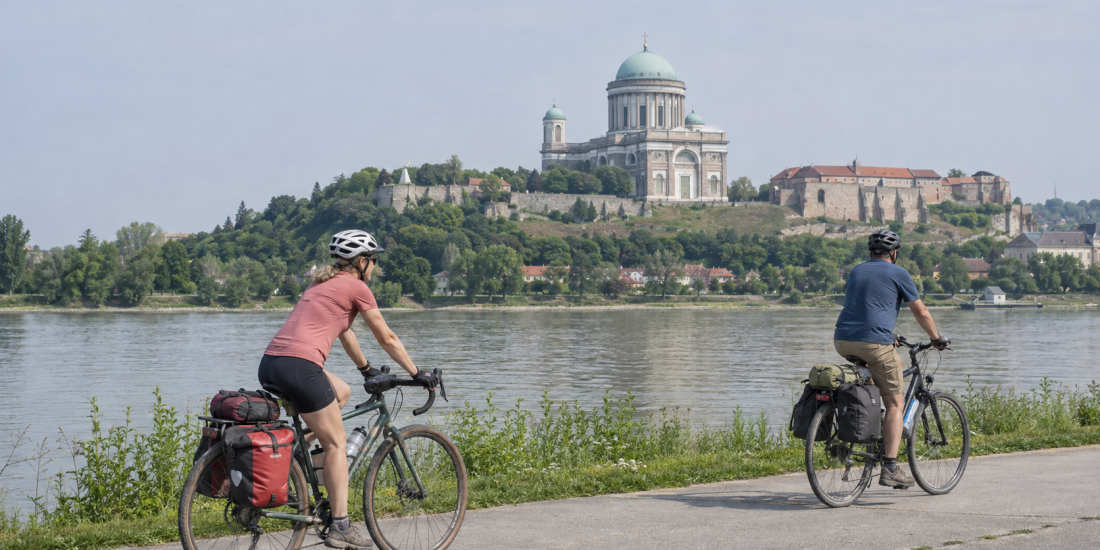
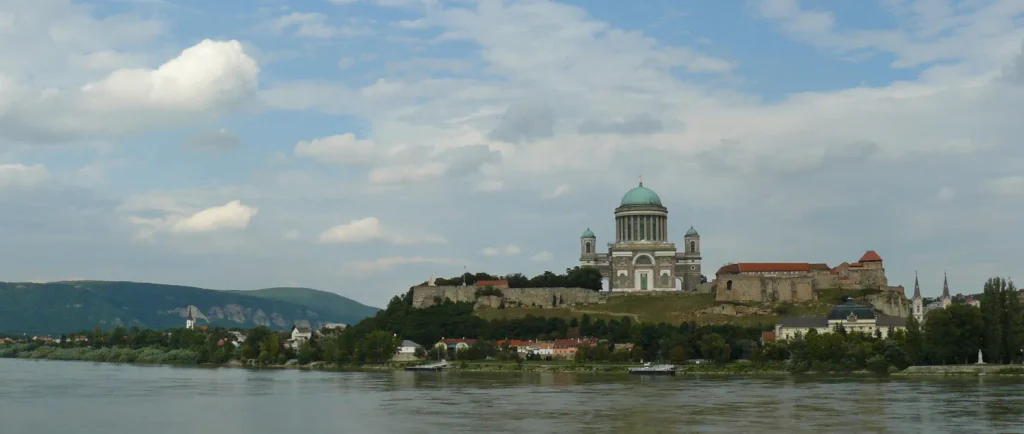
The view many visitors want of Esztergom is actually from Slovakia. From Štúrovo, the dome of the basilica stands above the opposite bank, with the river in the foreground. Use the Mária Valéria Bridge to put the viewpoint and the hotel on the right sides of your evening plan. If you want to go inside the basilica, check visiting arrangements for the day you arrive. Arriving on a bicycle at sunset and visiting an interior during opening hours require different schedules.
6–7. Through the Danube Bend: make the last crossing a deliberate choice
One way onward from Esztergom takes you through Slovakia and back to Hungary near Szob. From Szob, the Hungarian route follows the bend through Zebegény and Nagymaros, then runs towards Verőce and Vác. Across the river you see Visegrád and the hill above it. If the view is what you came for, you can stay on this bank. To visit Visegrád itself from Nagymaros, check the ferry both ways and allow extra time for the climb if you want the citadel. Szob–Vác route · Nagymaros–Visegrád ferry operator
At Vác the national route planner offers two materially different finishes. The Szentendre option starts with a ferry towards Tahitótfalu, then continues via Leányfalu, Szentendre and Óbuda. Pick this if you want a final small-town stop and an approach from the Buda side. The Dunakeszi option stays east of the river on the Vác–Dunakeszi and Dunakeszi–Budapest stages. It is a useful alternative if you are staying in Pest or want to avoid relying on the Vác ferry. Save both tracks before departure. Hungarian EuroVelo stages and GPX files
Check the crossing you actually need: the Visegrád timetable cannot tell you when the Vác ferry runs. Look up the date, direction, last departure, bicycle fare and whether the passenger ticket is separate. Wind, water level and seasonal operations can alter the plan. With a group, ask about bicycle capacity. The simplest fallback along the eastern bank is often the rail corridor through Szob, Nagymaros and Vác towards Budapest-Nyugati. Look for the bicycle symbol and check capacity on the specific service. MÁV guide to bikes in the Danube Bend

A seven-day budget, down to the last pickup
Here is a trip four adults could price for themselves. They share two twin rooms, rent four gravel bikes for seven days, carry their own clothes and hand back the bikes in Budapest. The eight hotel nights are Vienna, Bratislava, Mosonmagyaróvár, Győr, Komárom, Esztergom, Vác and Budapest. They return to Vienna as passengers on day nine.
| Expense | Calculation | Per rider | Four riders |
|---|---|---|---|
| Gravel bike | 7 days × €33 | €231.00 | €924 |
| Rack and panniers | 7 days × €5 | €35.00 | €140 |
| Bike delivery in Vienna and collection in Budapest | Example of a previous €270 group quote, split four ways | €67.50 | €270 |
| Accommodation | 8 nights averaging €110 per twin room, two sharing | €440.00 | €1,760 |
| Meals, snacks and water | Allow €35 a day for 8 day-equivalents across arrival, riding and departure | €280.00 | €1,120 |
| Ferries and local incidentals | Planning allowance | €25.00 | €100 |
| Budapest–Vienna passenger return | Illustrative rail allowance, bike already collected | €50.00 | €200 |
| Estimated spend | €1,128.50 | €4,514 | |
| With a 10% reserve | €1,241.35 | €4,965.40 |
The rental benchmark is the published seven-day rate for one Focus Atlas model, applied to four comparable bikes solely for this calculation. Four riders may need different models and rates. The €270 transport figure comes from a previous four-bike request; the 2027 quote depends on the dates, addresses and collection time. The hotel, food, ferry and rail lines are spending allowances, not live reservations. Travel to Vienna, a guide, daily luggage transfers, admission tickets, personal travel insurance and optional bike damage cover are outside the total. AustriaTrails Focus Atlas rates
How much can the hotels change the result? The €110 is a room average across three countries. A useful reality check is the Átrium Panzió in Esztergom, which lists a superior double at HUF 25,000 for two. At the other end, Rad+Reisen’s 2027 package lists extra four-star nights in Vienna or Budapest at €96 per person sharing a room. Those examples are different products, but they explain why the room unit matters. If your eight rooms average €150 instead of €110, add €160 per rider. Ask whether breakfast and city tax are included. Esztergom guesthouse prices · 2027 operator prices and inclusions
What changes for a couple or a solo rider? If the same €270 vehicle charge applied to two people, it would be €135 each. With the other assumptions unchanged, that couple would spend €1,196 per person, or €2,392 together before reserve. A solo rider using the same €110 rooms and paying the entire example vehicle charge would spend €1,771. Those are sensitivity tests. Ask for a quote for your own party before deciding whether a one-way rental or a rail return makes more sense.
What about the deposit? A refundable deposit is money you may have to provide at handover and should budget for separately from spending. At €100 per bike, a four-person group would set aside €400. Where the rental offer allows basic damage cover instead, a rate of €5 per bike per day would add €35 per rider for seven days. Check your chosen bike’s terms, especially for theft and major damage. Basic damage cover and personal travel cover address different losses. Deposit and bike damage options
What kind of holiday are you paying for?
A self-planned rider books rooms, carries luggage and makes the decisions when a crossing is suspended. A packaged self-guided holiday can include booked rooms, breakfast, route support and daily luggage transfer. As a concrete comparison, Rad+Reisen describes seven nights and daily baggage transfer on its 2027 itinerary; its page lists a trekking bike at €99 extra and an e-bike at €239 extra. These are add-ons to the operator’s holiday. Compare the whole invoice, the number of nights and the kilometres actually ridden.
The other decision is what happens to the bicycle at the finish. A Budapest collection pays for one vehicle journey and leaves you free to stay in Hungary, travel on or take a passenger train. Returning a bicycle by train can cost less for one person, but requires a train with space, a ticket for the bike and a handback at the agreed Austrian location. Four friends splitting a pickup have a different calculation from a solo traveller. If your party is flying home from Budapest, leave the Vienna return allowance out and substitute your actual onward travel.
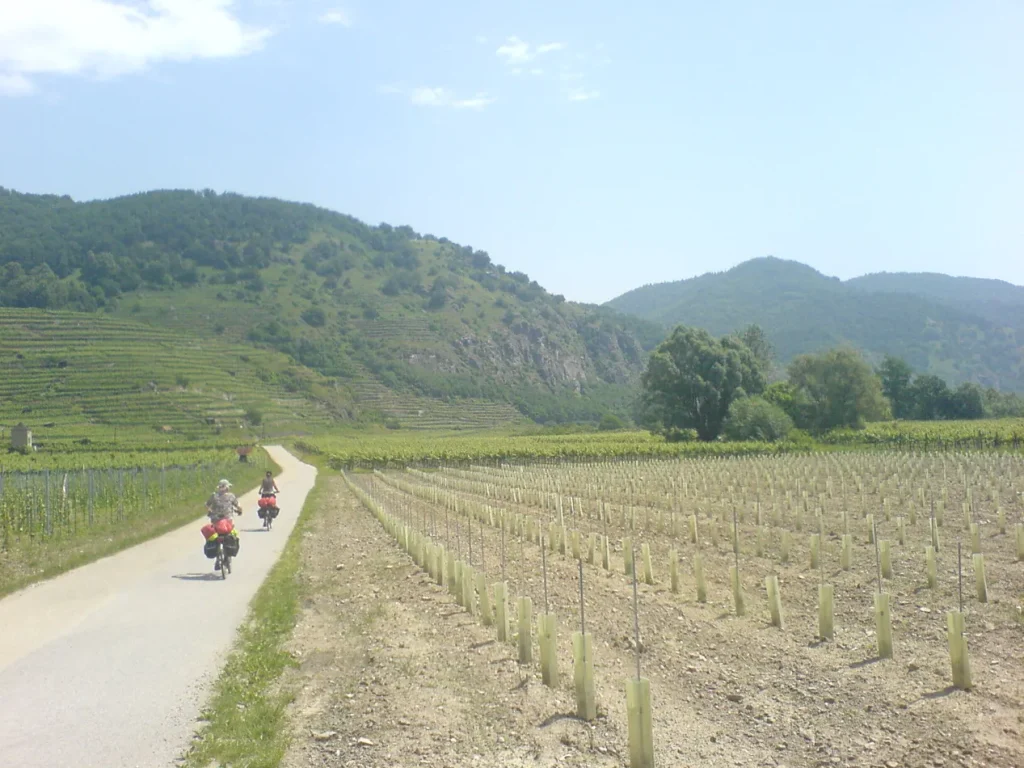

Which bike, and what should go in the panniers?
For mostly asphalt with some rougher links, a gravel bike with comfortable tyres is a practical choice if you already ride drop bars. A touring e-bike makes sense for a rider who prefers an upright position or wants help keeping pace into a headwind. A road bike can work on a carefully checked paved variant, provided its tyres and luggage setup suit the surface. An e-MTB adds weight and rolling resistance that the ordinary river itinerary rarely demands. For a group of different heights, confirm the fit of every bike before committing to one model for everyone.
On an e-bike, the relevant range is the longest day between reliable sockets. Load, assistance level, wind and rider effort change the result. Ask for the battery specification and charger, and ask each host whether charging is allowed and where. A locked cellar with no socket may be excellent storage for a gravel bike and inconvenient for an e-bike with a fixed battery. Confirm stairs and access hours too. A departure planned for 07:30 is awkward if reception holds the only key until 08:30.
Pack around the rain and the overnight stops. One riding outfit can dry while the other is in use. Add a light waterproof layer, warm layer, comfortable evening clothes, sunscreen, water bottles and food for stretches between villages. Keep the passport, phone, charger and payment cards in a dry bag you can take into a café. Put heavier items low and split them between panniers. Try the loaded bike before leaving Vienna: a heel striking a pannier on every pedal stroke is easily corrected at handover.
Check the actual contents of the repair kit. A spare tube must fit the wheel and valve, and the pump must fit the valve too. Know how to remove the wheel on the bike you are riding, or who to contact if you cannot. Ask the rental provider how to authorise a repair away from base and what evidence to retain. If the bike becomes unsafe to ride, a photo, a location pin and a description of the fault are far more useful than a message saying only “broken”.
Weather, navigation and the less obvious bookings
For sightseeing, I would look first at late spring or early autumn. Summer gives longer evenings but can make exposed embankments hot. Spring rain, autumn daylight and wind are more useful planning considerations than the word “flat” on the brochure. Cycling downstream does not give you a reliable tailwind. Check forecasts town by town before departure, and again for the next day each evening. Where high water affects floodplain paths or ferries, follow closures and use a verified alternative. Austrian Danube route information
Download offline maps and one GPX file per stage. Mark your hotel entrance, the correct ferry landing, one rail station and a food stop. Add an alternative finish for the longest day. On the route planner, look at the actual surface and road class wherever the track changes bank or leaves an embankment. A phone app can find a shorter road in seconds without knowing that one person in your party is uncomfortable in traffic.
Reserve the first night, the last night and any stop with a fixed ferry connection first. Then fill the gaps with cancellable accommodation where possible. A short email to a guesthouse should give the arrival date, group size, number of bikes and expected check-in time. Ask for secure storage, charging if needed, the full room price and breakfast time. For luggage transfer, check the bag limit, collection deadline and whether your next hotel accepts bags before you arrive. A final bike pickup in Budapest does not move luggage between hotels during the week.
Carry original travel documents. EU nationals can use a valid passport or national ID card for these countries. Travellers from outside the EU should check passport, visa and any applicable entry requirements for their nationality and travel date. Temporary checks are possible inside Schengen. Keep your emergency contact, rental agreement and insurance details accessible offline. The European emergency number is 112. EU travel documents · Entry rules for non-EU travellers
Can you shorten a stage or take the bikes back on the train?
Yes, on a service that carries bicycles and has space. In Hungary, the Danube Bend rail line is especially useful when someone wants a shorter last day. Check each leg separately if your journey involves changing trains. A group with four bikes needs four bike places. A child trailer, tandem or unusually heavy bicycle may have different restrictions. Remove panniers before boarding and leave enough time to find the correct carriage.
For Budapest to Vienna with a bike, look for an international service accepting assembled bicycles. ÖBB requires a bicycle ticket and a reserved bicycle space on its long-distance services. On ÖBB regional trains, bikes travel subject to available space and spaces generally cannot be reserved. If the booking system offers seats for people but no bike spaces, do not buy non-refundable passenger fares until you have a workable plan for the bikes. After a prearranged Budapest bike collection, you can book your return as ordinary passengers. ÖBB bicycle rules · MÁV international bicycle transport
Arranging a one-way rental with AustriaTrails
Send your rental dates, the number of riders, each person’s height, preferred bike type, pedal system and luggage requirements. Include the Vienna delivery address, the Budapest collection address or meeting pin, and a realistic time window at each end. Tell me if you have a fixed onward train or flight. A riverside finish for the group and a street where a van can stop may be a few minutes apart; agreeing on the same pin avoids a search at the end of a long week.
Morning handovers in Vienna are available from 09:00 by prior arrangement and can fill early. If you want to be riding before then, ask about delivery from 19:00 the evening before, and arrange secure overnight storage with the hotel. The quote should identify the rental period, bike sizes, bags, damage arrangements and both transport legs. For groups, payment can be arranged in full or with a booking prepayment and the balance at handover as set out in the offer. Bring the original identification requested for the rental. AustriaTrails booking and payment information
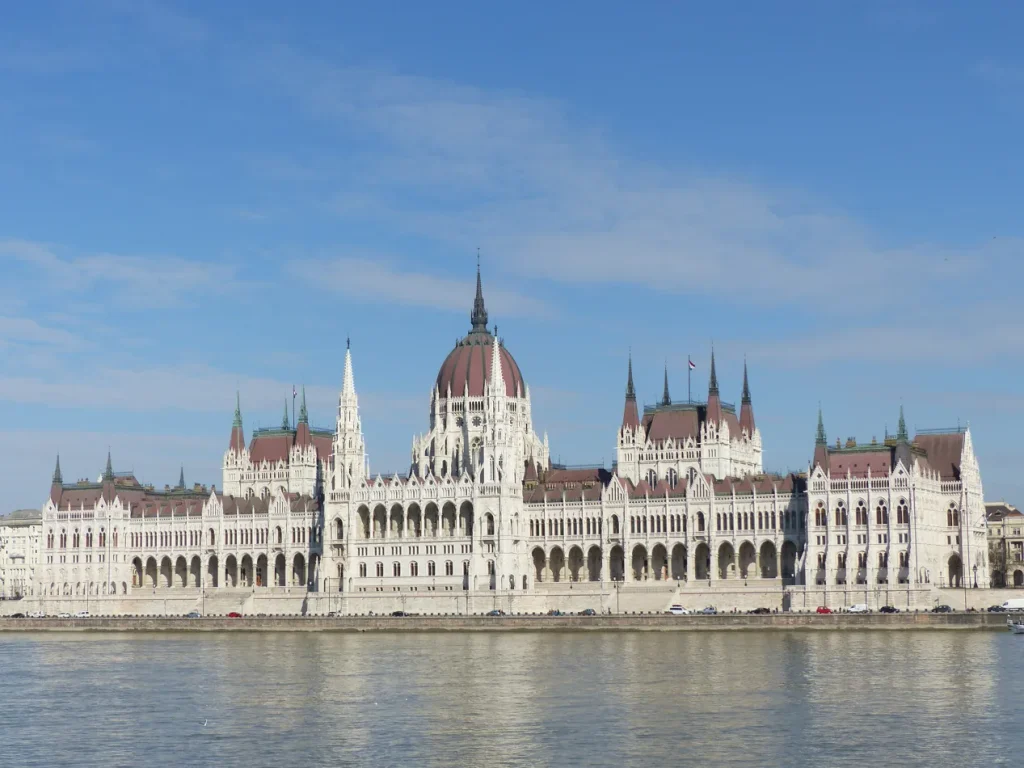
A final detail worth deciding before leaving Vienna is what you want to do on arrival. A group heading straight for a train needs a generous collection buffer. A group staying the night can arrange a hotel handback, take a shower and walk back to the river in time to see Parliament from the Buda bank. On a trip built around three capitals, an evening with no bicycles to organise is worth budgeting for.
Ask AustriaTrails about Vienna delivery and Budapest collection · Contact Yurii on WhatsApp
Planning edition for 2027. Sources and published price examples checked on 11 November 2026. Confirm room rates, rental availability, ferry operations and train reservations for your dates.
0 Comments