
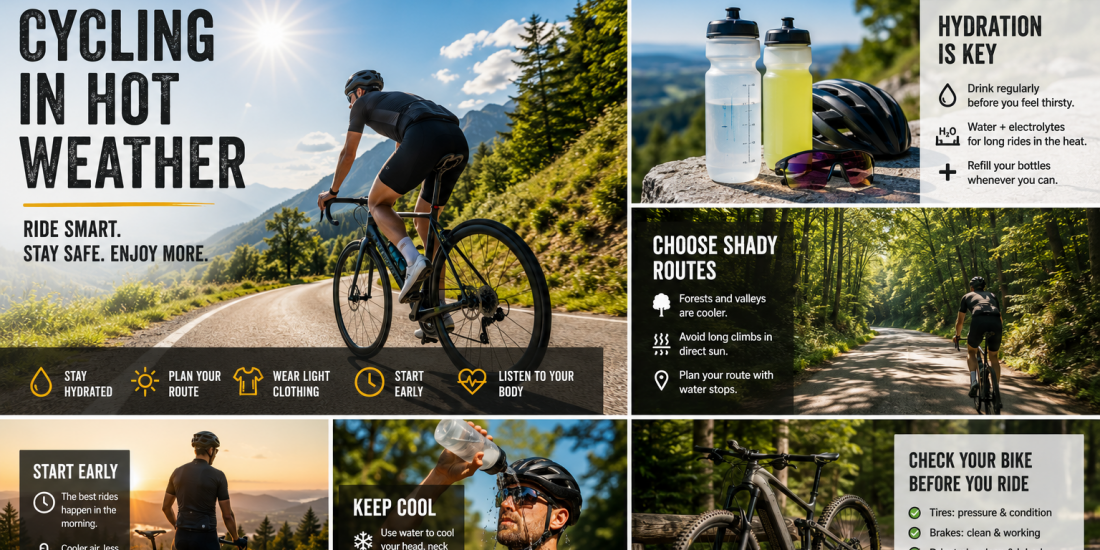
Cycling in Hot Weather: The Complete Guide to Safe and Enjoyable Summer Riding
Summertime cycling intro.
Long summer days, dry roads and warm evenings create excellent conditions for cycling. Whether you are exploring Austria on an e-bike, riding a gravel route through Lower Austria, training on a road bike or following shaded mountain bike trails in the Vienna Woods, summer can be one of the most enjoyable times of the year to ride.
However, cycling in hot weather places additional stress on the body. A route that feels comfortable at 18°C may become considerably harder at 30°C or more. Heart rate rises, sweating increases, dehydration develops faster and the body must devote more resources to controlling its internal temperature.
Heat does not automatically mean that you should leave the bicycle at home. It means that your ride should be approached differently.
The safest and most enjoyable summer cyclists are not necessarily those who tolerate the most discomfort. They are the riders who choose the right time of day, adjust their pace, carry enough fluids, recognise warning signs and are willing to change their plans when conditions become unsafe.
This guide explains how heat affects cycling performance, how much you may need to drink, when electrolytes become useful, what clothing works best, how to plan a hot-weather route and when you should stop riding.
Important: This article provides general information and is not a substitute for individual medical advice. People with cardiovascular, kidney, metabolic or other medical conditions, and those taking medication that may affect hydration or temperature regulation, should seek appropriate professional advice.
Quick answer: Is it safe to cycle in hot weather?
Cycling in hot weather can be safe when the rider is healthy, adequately prepared and able to adapt the duration and intensity of the ride to the conditions.
The risk increases when several factors occur together:
- high air temperature;
- strong direct sunlight;
- high humidity;
- little wind;
- long or steep climbs;
- high exercise intensity;
- inadequate hydration;
- lack of heat acclimatisation;
- illness, fatigue or poor recovery;
- limited access to water or shade.
There is no single temperature at which cycling suddenly becomes unsafe for every person. A trained and heat-acclimatised cyclist riding early in the morning may cope well with conditions that would be unsuitable for an unacclimatised rider starting a difficult climb in the afternoon.
Instead of looking only at the number on a thermometer, consider the entire situation: temperature, humidity, sun exposure, wind, route profile, duration, personal health and access to water.
Why cycling feels harder in the heat
The human body converts chemical energy from food into movement, but it is not perfectly efficient. Only part of the energy used by working muscles becomes mechanical power at the pedals. Much of the remaining energy is released as heat.
The harder you ride, the more heat your body produces.
To prevent an excessive rise in core temperature, the body transfers heat toward the skin and attempts to release it into the environment. During exercise, this happens through several mechanisms:
- radiation;
- convection;
- conduction;
- evaporation of sweat.
When the air is cool, the temperature difference between the skin and the environment helps the body release heat. As the air becomes warmer, that difference becomes smaller, and some cooling mechanisms become less effective.
At high temperatures, the evaporation of sweat becomes especially important.
Sweat on the skin does not necessarily mean effective cooling. Cooling occurs when the sweat evaporates. Sweat that simply runs off the body removes fluid and salt but provides less cooling benefit.
This is one reason why humidity matters so much.
Dry heat versus humid heat
A hot, dry day and a hot, humid day can create very different cycling conditions.
In dry air, sweat generally evaporates more easily. This can make the rider feel comparatively comfortable, although fluid loss may be substantial and easy to underestimate.
In humid air, evaporation becomes less efficient because the surrounding air already contains a high concentration of water vapour. The cyclist may sweat heavily while receiving less cooling from that sweat.
As a result, 29°C with high humidity can sometimes feel more stressful than a higher temperature in dry air.
Humidity can be especially challenging on:
- slow climbs;
- technical mountain bike sections;
- sheltered forest roads with little airflow;
- urban routes surrounded by heat-retaining buildings;
- rides after summer rain;
- low-speed e-bike tours with frequent stops.
Always consider the forecast for humidity and the apparent or “feels like” temperature, not only the official air temperature.
The cooling advantage of a bicycle
Cycling has one useful advantage over many other forms of outdoor exercise: speed creates airflow.
As the bicycle moves, air passes across the rider’s skin and clothing. This can support convective cooling and improve sweat evaporation.
A rider travelling at 25–30 km/h on a flat road may therefore feel more comfortable than a person walking in the same weather.
However, this advantage can be misleading.
The cooling effect decreases rapidly when speed falls. On a long climb, the rider may produce very high metabolic heat while moving at only 7–12 km/h. At the same time, the surrounding terrain may block natural wind.
This combination explains why steep climbs can become the most dangerous part of a hot-weather ride:
- power output is high;
- body heat production increases;
- speed and airflow decrease;
- direct sun exposure may be strong;
- stopping points may be limited.
The temperature may feel manageable on the flat road before the climb, but the same weather can become overwhelming after 20 minutes of continuous uphill riding.
How heat affects heart rate and cycling performance
During a ride, working muscles require blood to supply oxygen and nutrients. In hot conditions, the skin also requires increased blood flow to support heat dissipation.
The cardiovascular system must therefore serve two competing demands:
- deliver blood to the working muscles;
- move warm blood toward the skin.
Sweating also gradually reduces fluid volume. As plasma volume falls, the heart may need to beat faster to maintain cardiac output.
This can lead to a progressive rise in heart rate even when power output remains stable. Cyclists often call this cardiovascular drift.
For example, a rider may normally produce 180 watts at a heart rate of 135 beats per minute. During a long hot ride, the same 180 watts may eventually require 145 or 150 beats per minute.
Perceived effort may also rise.
The rider may feel that:
- the legs are unusually heavy;
- a normal endurance pace feels like tempo riding;
- breathing is harder than expected;
- familiar climbs feel significantly steeper;
- recovery after short efforts takes longer.
This does not necessarily mean that fitness has suddenly declined. Heat changes the physiological cost of the effort.
Should you follow power or heart rate in the heat?
Power remains useful because it measures external work. However, blindly maintaining normal cool-weather power targets can be a mistake.
On very hot days, combine several signals:
- power;
- heart rate;
- breathing;
- perceived effort;
- thermal discomfort;
- ability to concentrate;
- signs of dehydration.
If heart rate and perceived effort continue to rise at a steady power, reducing intensity is usually more sensible than forcing the original target.
For recreational cycling, it is often better to finish a slightly slower ride feeling well than to complete the planned numbers while becoming dangerously overheated.
What temperature is too hot for cycling?
There is no universal maximum cycling temperature.
Risk depends on the interaction between environmental conditions, exercise intensity and individual factors. Important considerations include:
- air temperature;
- relative humidity;
- direct solar radiation;
- wind speed;
- route surface;
- climbing intensity;
- ride duration;
- age and health;
- heat acclimatisation;
- access to shade and water.
A short, easy ride at 32°C on a shaded route may be manageable for an experienced rider. A four-hour ride at the same temperature, with several exposed climbs and no reliable water sources, presents a very different risk.
Be particularly cautious when:
- official heat warnings are active;
- the apparent temperature is extremely high;
- the night has remained hot and recovery was poor;
- the route is exposed and remote;
- you are not accustomed to the heat;
- you recently had a fever, stomach illness or infection;
- you already feel weak before starting;
- you cannot carry or refill enough water.
When conditions are extreme, postponing the ride is a valid and often intelligent decision.
The best time of day for summer cycling
Changing the start time is one of the simplest and most effective heat-management strategies.
During a heatwave, early morning is usually the best time for demanding cycling.
Depending on sunrise, route and local weather, a start between approximately 05:30 and 08:00 can offer:
- lower air temperatures;
- weaker solar radiation;
- cooler road surfaces;
- less traffic;
- more comfortable climbing;
- lower hydration requirements;
- a greater safety margin.
For a long route, try to complete the most demanding climbs before the hottest period of the day.
A rider planning a five-hour tour should think carefully before starting at 11:00 when temperatures above 30°C are forecast. Starting at 06:00 may allow most of the route to be completed before peak heat develops.
Evening rides are another option, but they have limitations. Roads, walls and buildings may continue radiating stored heat for hours after the highest daytime temperature. In urban areas, evenings can remain uncomfortably warm.
Avoid the hottest hours
As a general heat-safety principle, strenuous activity should be reduced or avoided during the hottest part of the day.
The precise period varies by location, but the strongest heat often occurs from early afternoon into late afternoon rather than exactly at noon.
Check an hourly forecast instead of relying on a single daily maximum.
How much should you drink while cycling in hot weather?
There is no perfect universal drinking rate.
Fluid needs vary substantially between cyclists and may depend on:
- body size;
- sweat rate;
- fitness;
- heat acclimatisation;
- riding intensity;
- temperature;
- humidity;
- clothing;
- duration;
- individual physiology.
One cyclist may lose less than 500 ml of sweat per hour. Another may lose more than one litre per hour under the same conditions.
Therefore, fixed instructions such as “everyone must drink exactly one litre per hour” are too simplistic.
A practical hydration strategy should aim to:
- begin the ride normally hydrated;
- drink regularly during prolonged riding;
- prevent excessive dehydration;
- avoid drinking far beyond actual needs;
- include sodium and other nutrients when appropriate.
Thirst is useful, but on long, hot or high-intensity rides it should not be your only planning tool. You should know where water is available before you start.
How to estimate your personal sweat rate
A basic sweat-rate test can help you plan future rides.
Step 1: Weigh yourself before the ride
Use minimal clothing and record your weight.
Example:
Pre-ride body weight: 80.0 kg
Step 2: Record everything you drink
Suppose you drink one litre during the ride.
Step 3: Weigh yourself after the ride
Dry excess sweat from the skin and use similar clothing conditions.
Example:
Post-ride body weight: 79.2 kg
Step 4: Estimate fluid loss
The body-weight decrease is approximately 0.8 kg, which is roughly equivalent to 0.8 litres of water.
Add the one litre consumed during the ride:
Estimated sweat loss: approximately 1.8 litres
If the ride lasted two hours:
Estimated sweat rate: approximately 0.9 litres per hour
Urination during the ride should be subtracted from the calculation, although this is uncommon during many shorter training rides.
This method is not laboratory-perfect, but it provides useful individual information.
Repeat the test in different conditions:
- mild weather;
- hot and dry weather;
- hot and humid weather;
- easy endurance riding;
- harder climbing sessions.
Over time, you will develop a much better understanding of how much fluid you typically lose.
Can a cyclist drink too much water?
Yes.
The message “stay hydrated” is important, but it should not be interpreted as “drink as much as physically possible.”
Excessive fluid intake, especially during very long events, can dilute sodium in the blood. This condition is known as exercise-associated hyponatraemia.
It is uncommon in normal short rides, but the risk can increase when a person repeatedly drinks large amounts of low-sodium fluid beyond what is being lost.
The goal is not to replace every drop of sweat at any cost.
The goal is to maintain a reasonable fluid balance while avoiding both severe dehydration and overdrinking.
Practical principles include:
- do not force extreme amounts of fluid;
- use your estimated sweat rate as guidance;
- consider electrolytes during long, sweaty rides;
- avoid gaining substantial body weight during an endurance event;
- adapt intake to changing conditions and intensity.
Water or sports drink?
For many short and easy rides, water is sufficient.
A sports drink becomes more useful when the ride is:
- long;
- intense;
- very hot;
- associated with heavy sweating;
- completed without regular food;
- part of a long training or touring day.
A well-designed sports drink can provide:
- water;
- sodium and other electrolytes;
- carbohydrates;
- flavour that may encourage drinking.
A practical approach for a summer ride is to carry two bottles:
Bottle one: plain water.
Bottle two: a diluted electrolyte or carbohydrate drink.
This provides flexibility. Water can be used for drinking or limited external cooling, while the second bottle supports energy and sodium intake.
Very concentrated drinks can become unpleasant in extreme heat and may contribute to gastrointestinal discomfort. Some riders prefer a more diluted drink while taking carbohydrates separately through food, gels or chews.
Electrolytes for cycling in the heat
Sweat contains water and dissolved electrolytes, particularly sodium and chloride.
Sweat sodium concentration differs widely between individuals. Some cyclists lose relatively little salt, while others develop visible white salt marks on their helmet straps, jersey, shorts or skin.
Electrolytes are unlikely to be essential for every short recreational ride. They become more relevant when:
- riding for several hours;
- sweating heavily;
- riding on consecutive hot days;
- participating in a long-distance event;
- consuming large amounts of plain water;
- visible salt deposits appear on clothing;
- the rider has previously experienced problems related to heavy sweating.
Electrolyte tablets can be convenient, but they are not magic performance products. They should be part of an overall plan that includes fluid, carbohydrate, pacing and recovery.
Taking excessive salt does not make a rider immune to heat illness.
What should you eat during a hot-weather ride?
Heat often reduces appetite, but energy expenditure continues.
A cyclist who rides for three to five hours may still require regular carbohydrate intake even when solid food feels less appealing.
Potential options include:
- bananas;
- energy gels;
- soft energy bars;
- rice cakes;
- fruit purée;
- small sandwiches;
- dried fruit;
- carbohydrate drink;
- easy-to-chew sweets or sports chews.
Choose foods that remain edible when warm.
Chocolate-heavy bars may melt, while very dry or dense food can become difficult to swallow when the mouth is dry.
For long rides, small and regular portions are usually easier to tolerate than one large meal.
A useful principle is to begin eating before energy levels collapse. Waiting until you feel completely empty often makes recovery during the ride more difficult.
Pre-ride hydration and preparation
A successful hot-weather ride begins before the first pedal stroke.
The day before
Drink normally throughout the day. There is usually no need for extreme water loading.
Eat regular meals containing:
- carbohydrates;
- protein;
- vegetables or fruit;
- normal dietary salt.
Avoid excessive alcohol, which can impair sleep, judgement and recovery.
Before departure
Check:
- hourly temperature;
- humidity;
- wind;
- UV index;
- weather warnings;
- possibility of thunderstorms;
- water refill points;
- public transport alternatives;
- mobile phone battery.
Begin the ride normally hydrated rather than trying to correct a large fluid deficit after starting.
Urine colour can provide a rough indication, although it is not a perfect scientific measure. Very dark urine before a hot endurance ride may suggest that more attention to hydration is needed.
Pre-cooling before cycling
Pre-cooling means lowering body temperature or increasing heat-storage capacity before exercise.
Competitive athletes may use cooling vests, ice slurries or controlled cold-water techniques. Recreational cyclists can use simpler methods.
Before a hot ride:
- remain indoors or in the shade while preparing;
- avoid standing in direct sun for 30 minutes before departure;
- drink a cool beverage;
- take a cool shower if comfortable;
- chill your bottles;
- use insulated bottles where practical;
- freeze part of a bottle so it gradually melts;
- avoid beginning the ride immediately after sitting in a very hot car.
Pre-cooling does not eliminate heat risk, but it may improve comfort during the first part of the ride.
Cooling yourself during the ride
Water can also be used externally to support cooling.
Cyclists often apply water to:
- the neck;
- head;
- face;
- forearms;
- upper back.
The benefit depends on evaporation and airflow. It may be less effective in very humid conditions, but the immediate sensation can still be helpful.
Do not pour away essential drinking water when your next refill opportunity is uncertain.
A better time for external cooling is often:
- at a public fountain;
- during a café stop;
- at an organised feed station;
- near a reliable water source;
- after refilling both bottles.
Avoid applying unknown or non-potable water near the mouth or into bottles.
Choosing cycling clothing for hot weather
Good summer cycling clothing should support evaporation while protecting the skin from sunlight.
Look for:
- lightweight materials;
- breathable fabrics;
- effective moisture transport;
- a close but non-restrictive fit;
- well-ventilated panels;
- suitable UV protection.
A completely open jersey is not always the coolest or safest option. Exposed skin receives direct solar radiation and can burn.
Light arm sleeves designed for summer use may provide UV protection and, when damp, can sometimes support evaporative cooling.
Dark clothing can absorb more solar energy, although fabric design, ventilation and fit also matter.
The best clothing is not simply the lightest item. It should balance:
- ventilation;
- comfort;
- sun protection;
- chafing prevention;
- pocket capacity;
- visibility in traffic.
Sunscreen for cyclists
Cyclists can remain exposed to ultraviolet radiation for several hours.
Commonly missed areas include:
- the back of the neck;
- ears;
- nose;
- cheeks;
- lower arms;
- the gap between jersey and shorts;
- thighs above the leg gripper;
- backs of the hands;
- exposed scalp.
Use a broad-spectrum, water-resistant sunscreen with a suitable protection factor. Apply it before dressing so that jersey edges and straps do not leave unprotected gaps.
For long rides, reapplication may be necessary, especially after heavy sweating.
Do not assume that airflow makes the sun less intense. The rider may feel cool while still receiving substantial UV exposure.
Is a cycling helmet too hot in summer?
A modern cycling helmet is designed with ventilation channels that allow air to pass through while riding.
Ventilation works best at higher speeds and becomes less effective during slow climbing. Nevertheless, the safety benefit of a helmet remains important.
Choose a helmet that:
- fits correctly;
- has effective ventilation;
- is not blocked by thick fabric underneath;
- allows sweat to be managed without obstructing vision.
A thin cycling cap or sweatband may help prevent sweat from running into the eyes, but heavy headwear can reduce airflow.
Never compromise helmet fit by placing bulky cooling products underneath it.
Pacing a ride in extreme heat
The most common pacing mistake is starting at a normal cool-weather intensity and waiting until the heat becomes unbearable.
By then, core temperature, heart rate and dehydration may already be rising.
A better strategy is to reduce intensity from the beginning.
Practical pacing adjustments
- Use easier gears on climbs.
- Keep breathing controlled.
- Avoid repeated maximum efforts.
- Reduce average power expectations.
- Take short breaks in shade.
- Stop before symptoms become severe.
- Treat heart-rate drift as useful information.
- Allow more recovery after hard sections.
If you use a cycling computer, do not let a target speed or average power override obvious physical warning signs.
Hot-weather riding is not the right time to chase every personal record.
Why long climbs are especially difficult in hot weather
Long climbs combine high heat production with reduced cooling.
Compared with fast riding on flat terrain:
- speed is lower;
- airflow is weaker;
- muscular work is higher;
- the rider may remain in direct sun for a long period;
- road temperature may be high;
- shade and water may be limited.
When planning a summer route, examine not only total elevation but also the location and duration of the climbs.
A 500-metre climb beginning at 07:00 may be reasonable. The same climb beginning at 14:00 on an exposed southern slope may be significantly more demanding.
On the climb:
- start conservatively;
- use a lower gear;
- maintain a sustainable cadence;
- drink before reaching the steepest section;
- avoid racing other riders;
- use shaded stopping points;
- consider turning around if conditions deteriorate.
Road cycling versus mountain biking in the heat
Both disciplines offer advantages and disadvantages.
Road cycling
Advantages:
- higher speed creates more airflow;
- water and food may be easier to find;
- routes can be shortened quickly;
- public transport may be accessible.
Disadvantages:
- exposed asphalt becomes extremely hot;
- shade may be limited;
- traffic adds stress;
- open agricultural areas can provide little shelter;
- road surfaces radiate heat.
Mountain biking
Advantages:
- forest trails often provide shade;
- natural surroundings may feel cooler;
- streams and shaded valleys can reduce thermal stress;
- speed targets are less important.
Disadvantages:
- slow technical climbs generate substantial heat;
- airflow may be limited;
- remote routes can lack drinking water;
- mechanical problems may leave the rider far from help;
- some forests become humid and windless.
In Lower Austria and the Vienna Woods, a shaded mountain bike route can be an excellent summer choice, but it still requires sufficient water and realistic planning.
Gravel cycling in hot conditions
Gravel riding often combines long distances, exposed farm roads and limited access to shops or fountains.
The surface itself also affects effort. Loose gravel, dust and repeated short climbs may require more energy than a paved route of the same distance.
Before a summer gravel ride:
- identify reliable refill points;
- do not assume every village fountain provides drinking water;
- carry more water than for an urban road ride;
- consider a hydration pack;
- bring a tubeless repair kit or spare tube;
- check mobile coverage;
- plan an emergency shortcut;
- avoid the most exposed sectors at peak heat.
A remote gravel adventure should never depend on a single bottle.
E-bike riding in hot weather
E-bikes can make summer cycling more accessible because electric assistance reduces the rider’s required power output.
On a difficult climb, increasing assistance may:
- reduce metabolic heat production;
- lower cardiovascular strain;
- help the rider maintain airflow;
- make it easier to reach shade or water.
However, the battery also requires sensible treatment.
Modern e-bikes can normally be used in warm summer conditions, but prolonged exposure to extreme heat should be avoided.
Do not leave an e-bike battery:
- inside a closed vehicle in direct sun;
- on hot asphalt for hours;
- beside a strong heat source;
- charging in an unventilated, extremely hot space.
When stopping, park the bike in shade where possible.
Do not immediately assume that reduced range indicates battery damage. Hot-weather range can also be affected by route profile, assistance level, rider weight, tyre pressure and wind.
For visitors who want to explore Austria without bringing their own bicycle, AustriaTrails offers a selection of e-bikes, mountain bikes and gravel bikes for rental in the Vienna and Lower Austria region.
Suggested internal link:
Explore AustriaTrails bike rentals
Heat acclimatisation: Can your body adapt?
The body can partially adapt to repeated exercise in hot conditions.
This process is known as heat acclimatisation or heat acclimation, depending on whether adaptation occurs naturally outdoors or in controlled conditions.
Potential adaptations may include:
- earlier onset of sweating;
- increased sweat capacity;
- improved skin blood flow;
- expanded plasma volume;
- lower heart rate at a given workload;
- improved thermal comfort;
- better ability to maintain performance.
These adaptations do not happen after one difficult ride.
A commonly used approach involves repeated heat exposure over approximately one to two weeks. The optimal protocol depends on the athlete, environment and objective.
For recreational cyclists, the important message is gradual progression.
During the first hot days of summer:
- reduce duration;
- reduce intensity;
- choose familiar routes;
- stay close to water;
- allow more recovery;
- avoid starting with an all-day mountain tour.
Heat acclimatisation improves tolerance, but it does not make a cyclist invulnerable.
Why the first heatwave can be especially dangerous
The first very hot period after a cool spring often creates more risk than similar temperatures later in the summer.
The body may not yet be adapted. Riders may also continue using the same pace, clothing and route plans that worked in mild weather.
During the first heatwave:
- shorten the first few rides;
- avoid peak afternoon conditions;
- monitor heart rate more carefully;
- increase access to fluids;
- do not combine extreme heat with maximum training intensity;
- allow several days for adaptation.
A cyclist who handled 33°C in August should not assume the same tolerance during an abrupt hot spell in May or June.
Warning signs of heat exhaustion
Heat exhaustion can develop when heat exposure, physical effort and fluid loss overwhelm the body’s ability to cope.
Possible warning signs include:
- heavy sweating;
- unusual fatigue;
- weakness;
- dizziness;
- headache;
- nausea;
- muscle cramps;
- rapid pulse;
- reduced coordination;
- feeling faint;
- unusually poor performance.
If these symptoms appear:
- stop riding;
- move to shade or a cool indoor location;
- remove unnecessary layers;
- begin cooling;
- drink appropriate fluids if the person is conscious and able to swallow;
- seek medical assessment if symptoms are severe, persistent or worsening.
Do not attempt to “push through” significant heat symptoms to finish a planned route.
Heat stroke: A medical emergency
Heat stroke is much more serious than ordinary fatigue.
Potential signs include:
- confusion;
- disorientation;
- abnormal behaviour;
- inability to coordinate movement;
- collapse;
- seizure;
- loss of consciousness;
- very high body temperature.
A person experiencing heat stroke may still be sweating. The absence of dry skin does not rule it out.
Heat stroke requires urgent medical assistance and rapid cooling.
Call the local emergency number. In Austria and throughout the European Union, 112 can be used for emergencies. Austria’s ambulance number is 144.
While waiting for professional help:
- move the person out of direct sun;
- remove unnecessary outer clothing;
- begin active cooling;
- follow emergency-service instructions;
- do not leave the person alone.
A confused cyclist should not be allowed to continue riding.
Heat cramps and severe muscle symptoms
Muscle cramps can occur during prolonged exercise, but they are not always caused by one simple factor.
Fatigue, pacing, training status, fluid balance and electrolyte losses may all contribute.
A mild cramp is not automatically a heat emergency. However, severe cramping combined with weakness, nausea, dizziness or altered behaviour should be taken seriously.
Extremely painful muscles, profound weakness or unusually dark urine after heavy exertion can indicate a more serious medical problem and require prompt assessment.
Who should be especially careful?
Some people are more vulnerable to heat-related problems.
Extra caution may be appropriate for:
- older adults;
- children and teenagers;
- people with cardiovascular disease;
- people with kidney disease;
- people with diabetes;
- individuals taking certain medications;
- riders recovering from illness;
- people who are not acclimatised;
- riders with previous heat illness;
- cyclists who slept poorly or consumed substantial alcohol;
- people beginning exercise with an existing fluid deficit.
Medication can affect sweating, blood pressure, heart rate, kidney function or fluid balance. Do not stop prescribed medication without medical advice, but seek guidance on exercising safely in hot conditions.
Alcohol, caffeine and summer cycling
Alcohol
Alcohol before or during a ride is a poor heat-management strategy.
It can impair:
- reaction time;
- balance;
- judgement;
- sleep;
- recovery;
- hydration behaviour.
A cold beer after a ride may be culturally popular, but water, food and appropriate rehydration should come first after prolonged exercise in the heat.
Caffeine
Moderate caffeine intake does not automatically cause dangerous dehydration in habitual coffee drinkers.
However, coffee is not a substitute for a hydration plan.
A morning espresso may be compatible with a summer ride, but the rider still needs sufficient water and, where appropriate, electrolytes.
High caffeine intake may also increase feelings of nervousness or make an already elevated heart rate feel uncomfortable.
Is cold water bad during exercise?
Healthy cyclists generally do not need to avoid cold drinks during hot-weather riding.
Cool fluids may:
- improve comfort;
- encourage drinking;
- support thermal management;
- feel refreshing during long rides.
Some people experience stomach discomfort when consuming a large amount of very cold fluid quickly.
The practical solution is not necessarily warm water. It is often to drink smaller amounts regularly.
Choose a temperature that you tolerate well.
How to plan a three-hour ride in hot weather
Assume that the forecast predicts:
- 31–33°C;
- strong sun;
- moderate humidity;
- a three-hour route;
- several short climbs.
A sensible plan could look like this.
The evening before
- Eat a normal balanced meal.
- Drink normally.
- Avoid excessive alcohol.
- Charge the phone and cycling computer.
- Check the route for water.
- Prepare two or more bottles.
Before the ride
- Start early.
- Eat a familiar breakfast.
- Apply sunscreen.
- Fill bottles with cool fluid.
- Carry an electrolyte option.
- Inform someone of the route if riding remotely.
During the first hour
- Ride more conservatively than usual.
- Begin drinking early.
- Avoid chasing a fast average speed.
- Monitor heart rate and perceived effort.
During the second hour
- Refill bottles if possible.
- Eat before hunger becomes severe.
- Use shade for stops.
- Evaluate whether conditions are developing as forecast.
During the final hour
- Reduce intensity if heart rate continues rising.
- Take a shortcut if fluid is running low.
- Do not turn a safe training ride into a survival exercise.
After the ride
- Move into shade or a cooler environment.
- Continue drinking according to thirst and losses.
- Eat a meal containing carbohydrate, protein and normal dietary salt.
- Change out of wet clothing.
- Monitor for persistent headache, nausea, weakness or confusion.
Route planning for cycling in Austria during summer
Austria offers exceptional summer cycling, but route selection should reflect the weather.
A comfortable route is not defined only by distance and elevation.
Also consider:
- percentage of shade;
- direction of sun exposure;
- length of continuous climbs;
- drinking-water availability;
- distance between villages;
- railway connections;
- mobile coverage;
- places to buy food;
- possible escape routes;
- thunderstorm risk.
Vienna and Lower Austria
Summer routes around Vienna, Mödling, Baden and the Vienna Woods can vary greatly in thermal exposure.
Open sections through vineyards and agricultural land may become extremely hot under direct sun. Forest routes around the Wienerwald may provide more shade, although slow climbing and humidity can remain challenging.
Routes near towns have an additional advantage: easier access to cafés, supermarkets, railway stations and public transport.
For visitors, a professionally maintained rental bicycle can make route planning easier. AustriaTrails provides mountain bikes, gravel bikes, road-oriented options and e-bikes for exploring Vienna, Lower Austria and other Austrian regions.
Suggested internal link:
How to rent a bike from AustriaTrails
Mountain biking in the Vienna Woods during hot weather
The Vienna Woods are often an attractive alternative to exposed summer roads.
Forested sections can offer:
- shade;
- reduced direct radiation;
- cooler-feeling surroundings;
- protection from strong sun;
- more opportunities for rest.
However, riders should not underestimate:
- steep forest climbs;
- limited airflow;
- humidity;
- remote trail sections;
- reduced access to drinking water;
- changing trail conditions after storms.
Carry sufficient fluid and use only legal, officially permitted cycling routes.
Weather conditions can change quickly in summer, and thunderstorms may create falling branches, slippery surfaces and flash flooding in low areas.
Summer thunderstorms and cycling safety
Heat is not the only summer hazard.
Warm and humid days can produce intense thunderstorms, sometimes with little practical warning.
Before leaving:
- check an hourly forecast;
- review rain radar;
- note storm warnings;
- avoid exposed ridges if storms are possible;
- know where buildings or safe transport connections are located.
If thunder is audible, lightning is close enough to present a risk.
Do not shelter:
- beneath an isolated tall tree;
- on an exposed summit;
- beside metal fencing;
- in an open field;
- near water.
A simple open shelter may protect from rain but not necessarily from lightning.
When severe storms are forecast, changing the route or cancelling the ride is safer than depending on luck.
Hot-weather bike maintenance
Heat and dry summer conditions can also affect the bicycle.
Before a long ride, check:
- tyre pressure;
- tyre condition;
- brake function;
- chain lubrication;
- shifting;
- wheel security;
- e-bike battery charge;
- hydration-pack condition;
- bottle-cage bolts.
Dry and dusty trails can contaminate the drivetrain. A chain may become noisy sooner, especially after repeated off-road rides.
Do not overinflate tyres simply because the road is dry. Tyre pressure naturally rises as temperature increases, and excessive pressure can reduce comfort and grip.
After a dusty ride:
- wipe the chain;
- clean the drivetrain appropriately;
- inspect brake pads;
- check tyres for cuts;
- remove sweat residue from the bicycle;
- avoid spraying high-pressure water directly into bearings.
Sweat contains salt and can contribute to corrosion, particularly around:
- handlebar bolts;
- headset components;
- brake levers;
- indoor trainer areas;
- frame hardware.
For inspection, adjustment or a complete service, AustriaTrails offers professional bicycle servicing with collection and return options in the local service area.
Suggested internal link:
Professional bicycle service by AustriaTrails
What to carry on a long summer ride
A hot-weather ride may require more equipment than a short ride in mild conditions.
Consider carrying:
- two large bottles or a hydration pack;
- electrolyte tablets or drink powder;
- sufficient carbohydrate food;
- sunscreen;
- mobile phone;
- power bank for long routes;
- payment card or cash;
- identification;
- compact first-aid supplies;
- spare tube or tubeless repair kit;
- tyre levers;
- pump or CO₂ inflator;
- multitool;
- lightweight emergency layer;
- route map available offline.
Water is the most important additional planning factor.
Two 750 ml bottles may be adequate for part of a ride but not necessarily for an entire four- or five-hour tour in extreme heat.
Plan refills rather than hoping to find them.
Ten essential rules for cycling in hot weather
- Start early. Complete demanding sections before peak heat.
- Check more than temperature. Consider humidity, sun, wind and weather warnings.
- Begin hydrated. Do not start a long ride with a significant fluid deficit.
- Carry enough water. Know exactly where bottles can be refilled.
- Use electrolytes when appropriate. They may be useful during long and sweaty rides.
- Reduce intensity. Normal cool-weather targets may be unrealistic.
- Choose shaded routes. Forest roads and valleys may be preferable to exposed asphalt.
- Protect your skin. Use sunscreen and suitable cycling clothing.
- Recognise warning signs. Weakness, dizziness, nausea and confusion must not be ignored.
- Be willing to stop. Shortening a ride is better than creating a medical emergency.
Common mistakes cyclists make in hot weather
Starting too late
A midday start can place the most difficult section of the route directly in peak heat.
Carrying only one bottle
This may be sufficient for a short urban ride, but not for a long rural or mountain route.
Riding at normal power
Maintaining cool-weather training targets can cause unnecessary cardiovascular and thermal stress.
Waiting until severe thirst
A long hot ride should have a planned hydration strategy.
Drinking only plain water for many hours
For prolonged heavy sweating, electrolytes and food may become important.
Pouring away all drinking water
External cooling is helpful only when enough fluid remains for drinking.
Ignoring humidity
A moderate temperature with high humidity can create severe thermal stress.
Assuming forest means safe
Shade helps, but steep climbs, humidity and remoteness still matter.
Refusing to shorten the route
A planned distance is never more important than health.
Leaving an e-bike in a hot car
The temperature inside a parked vehicle can become far higher than the outdoor temperature.
Frequently asked questions about cycling in hot weather
Is cycling in 30°C weather safe?
It can be safe for a healthy and prepared cyclist, particularly during a short, low-intensity ride with access to water. Risk increases with humidity, direct sun, long climbs, high intensity and lack of acclimatisation.
Is 35°C too hot for cycling?
For many riders, 35°C represents a substantial heat load. A short early-morning ride may be possible in some conditions, but long or intense riding in direct afternoon sun may be inappropriate. Consider official warnings, humidity, route exposure and your own health.
How much water should I drink per hour while cycling?
There is no universal amount. Needs vary according to sweat rate, temperature, humidity, body size and intensity. Estimate your personal sweat losses and avoid both severe dehydration and excessive drinking.
Should cyclists use electrolytes in hot weather?
Electrolytes can be useful during long rides, heavy sweating or repeated hot-weather training. They are usually less important during a short, easy ride when normal food and water are sufficient.
Is water enough for a two-hour bike ride?
For an easy ride in moderate conditions, it may be. During high heat or intense exercise, a drink containing electrolytes and possibly carbohydrates may be more useful.
What are the first signs of heat exhaustion?
Possible signs include unusual weakness, heavy sweating, dizziness, headache, nausea, cramps, rapid pulse and feeling faint. Stop riding and move to a cool place.
Can I ride an e-bike in hot weather?
Yes, within the manufacturer’s operating guidance. Use greater assistance to reduce physical strain when necessary and avoid leaving the battery in a closed hot vehicle or direct sun for prolonged periods.
What should I wear for cycling in summer?
Choose lightweight, breathable cycling clothing with effective moisture management and suitable sun protection. Use sunscreen on exposed areas and wear a well-ventilated helmet.
Is morning or evening better for summer cycling?
Morning is often cooler because roads and buildings have not yet stored a full day of heat. Evening can also work, but urban and paved areas may remain hot after sunset.
Should I stop if my heart rate is unusually high?
An unusually high or steadily rising heart rate at normal power can indicate increasing heat strain or dehydration. Reduce intensity, cool down and reassess the ride. Stop if you feel weak, dizzy, confused or unwell.
Does pouring water over the head help?
It can provide cooling, particularly when airflow allows evaporation. Do not use essential drinking water for cooling when refill opportunities are uncertain.
Can heat cause lower cycling power?
Yes. Heat increases cardiovascular strain and perceived effort, and the body may reduce sustainable power to protect itself from excessive thermal stress.
Cycling in Austria with AustriaTrails
Summer is an excellent season for exploring Austria by bicycle, provided that the route, equipment and timing are appropriate for the weather.
AustriaTrails supports cyclists and visitors with:
- mountain bike rental;
- e-bike rental;
- gravel bike rental;
- professionally prepared bicycles;
- cycling tours and local route experience;
- flexible bike-rental solutions;
- professional bicycle servicing;
- collection and return services within the local workshop area.
Whether you want to discover the Vienna Woods, ride through Lower Austria, plan a multi-day cycling journey or simply rent a reliable bicycle near Vienna, choosing suitable equipment can make the experience safer and more enjoyable.
Useful AustriaTrails pages:
- Bike rental and cycling services in Austria
- How to rent a bicycle from AustriaTrails
- E-bike touring in Austria
- Flexible bike rentals across Austria
- Professional bicycle service
- Contact AustriaTrails
Conclusion: Smart cyclists respect the heat
Cycling in hot weather can be safe, memorable and enjoyable. Summer provides long daylight hours, beautiful landscapes and excellent opportunities to explore Austria on two wheels.
However, heat changes the physical demands of every ride.
The body must provide energy to the muscles while simultaneously sending blood toward the skin and producing sweat. As the ride continues, dehydration, rising core temperature and cardiovascular drift may make a familiar pace increasingly difficult.
The key strategies are simple:
- start early;
- plan reliable water stops;
- reduce intensity;
- use electrolytes when appropriate;
- choose shaded routes;
- protect yourself from the sun;
- monitor your physical condition;
- stop when warning signs appear.
Do not expect the same speed, power or distance at 35°C that you achieve at 20°C.
A slower ride is not a failed ride. A shortened route is not a failure. Taking a train home, calling for assistance or postponing a tour can be the most responsible decision.
The goal is not to defeat the heat.
The goal is to understand it, adapt to it and return safely—with enough energy to enjoy the next ride.
Editorial references
This article was prepared using general heat-health and exercise-safety guidance from organisations including:
- World Health Organization;
- WHO Regional Office for Europe;
- Centers for Disease Control and Prevention;
- National Institute for Occupational Safety and Health;
- American College of Sports Medicine.
Medical recommendations may change as new evidence becomes available. Readers should follow current local weather warnings and seek individual medical advice where necessary.
0 Comments