
Bike Rental Near Vienna: How a Small Guntramsdorf Business Is Rethinking the Rental Experience
Around 40 bicycles, a professional workshop, flexible delivery arrangements and a highly personal approach to customer service. Behind AustriaTrails, a bicycle rental company in Lower Austria, is a Ukrainian entrepreneur who believes that renting a bicycle should sometimes offer a better experience than riding your own.
Guntramsdorf, Lower Austria — October 2026
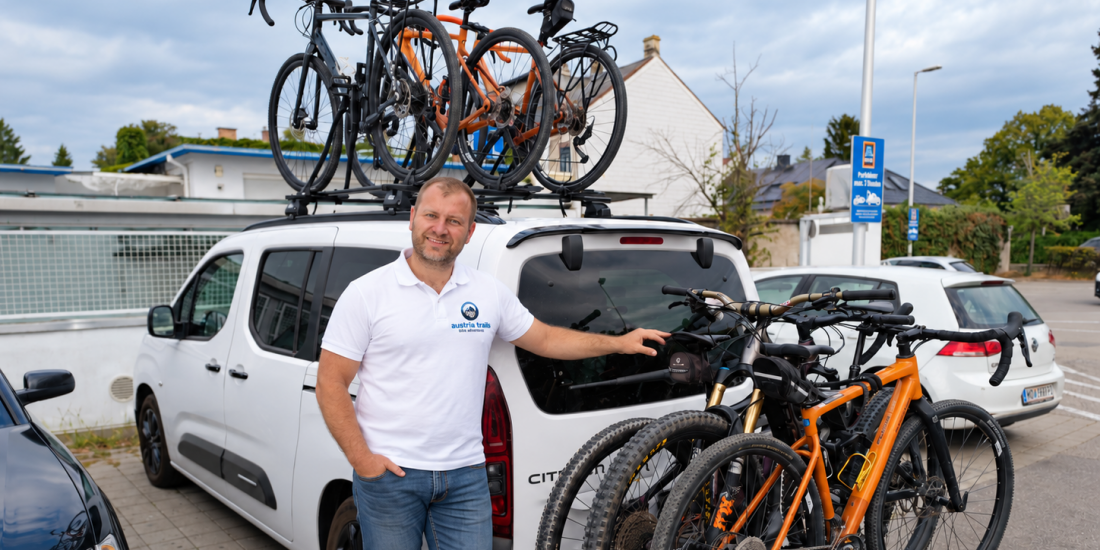
A white van stands in a parking area, its roof and rear-mounted racks filled with bicycles. There are road and gravel bikes alongside heavier electric mountain bikes. It is the kind of vehicle that could easily belong to a cycling club heading away for the weekend.
Instead, it is part of an increasingly busy small business operating just south of Vienna.
The company is called AustriaTrails, and behind it is Yurii Panchenko, a bicycle mechanic and cycling enthusiast whose professional involvement in the industry stretches back more than two decades.
From a base in Guntramsdorf, in the district of Mödling, Panchenko runs a bicycle rental operation serving Vienna, Baden, Mödling and the surrounding communities.
Unlike a conventional city-bike sharing scheme, AustriaTrails specialises in individual bicycle rentals: equipment chosen for a particular rider, prepared for a particular journey and, when requested, delivered to an agreed location.
What began as a relatively small rental project in 2024 has grown into a fleet of approximately 40 bicycles, spanning several cycling disciplines.
But the number of bicycles is only part of the story. The more revealing question is how a comparatively small operator intends to compete in a market where customers can choose between public bike-sharing systems, large tourist rental companies and established sports shops.
Panchenko’s answer centres on three things: technical condition, flexibility and personal responsibility.
A Business Built on More Than 20 Years of Cycling Experience
AustriaTrails is not Panchenko’s first involvement in the bicycle industry.
His professional background goes back to 2005, when he established BIKESHOP.UA, a bicycle-focused online retail business in Ukraine.
Over the following years, his activities expanded into cycling tourism, technical work and the organisation of cycling experiences.
In 2011, he launched MountainBike Ukraine, a project dedicated to cycling adventures and guided rides.
According to his professional biography, Panchenko has spent approximately 25 years involved in cycling, with experience covering mountain biking, road cycling, gravel riding and long-distance travel. He also reports having cycled in 35 countries.
His move to Austria, however, was not originally part of a conventional business expansion.
In March 2022, ABC News reported on Panchenko’s efforts to raise money for Ukraine through his existing cycling business after fleeing the Russian invasion.
At that time, he was already working as a bicycle mechanic in Austria.
The same year, he began developing a mobile bicycle repair service in Bad Vöslau. His activities subsequently expanded to local cycling experiences and, in February 2024, bicycle rental in the Vienna and Lower Austria region.
The next major development came in January 2026, when AustriaTrails established its own professional bicycle workshop in Guntramsdorf.
Today, this workshop is central to the rental business. It is where bicycles are inspected, maintained, repaired and prepared for their next customers.
The progression from online bicycle retail to a rental fleet with an in-house workshop has given the business an unusual combination of mechanical, logistical and customer-service experience.
Around 40 Bicycles — But Not 40 Identical Bikes
One of the more distinctive aspects of AustriaTrails is its range of equipment.
Rather than building a large collection of identical city bicycles, the company has developed a mixed fleet intended for different types of riders.
Its approximately 40 bicycles fall into five principal categories: gravel bikes, road bikes, mountain bikes, electric mountain bikes and electric touring bicycles.
The distinction matters because the people renting bicycles around Vienna often have very different expectations.
Someone planning a relaxed ride through the vineyards of the Thermenregion may want a comfortable electrically assisted touring bicycle.
A visitor preparing for a multi-day ride along the Danube may prefer a gravel bicycle with suitable luggage equipment.
A mountain biker exploring the Vienna Woods will be interested in tyres, suspension performance and climbing capability.
And a road cyclist visiting Austria for a week may want a lightweight carbon bicycle with the correct frame size and pedal system.
The AustriaTrails rental catalogue reflects these differences.
Gravel bikes: Versatility for Lower Austria
The gravel selection includes models from Focus, Cannondale and Pride, among others.
Bicycles such as the Focus Atlas and Cannondale Topstone are designed for riders who want to combine paved roads with suitable unpaved surfaces.
This is particularly relevant around Vienna, Mödling, Gumpoldskirchen and Baden, where routes can transition from asphalt to gravel tracks and vineyard roads within a relatively short distance.
Gravel bicycles also serve visitors planning longer journeys, including the Danube cycling corridor.
Road bikes: Equipment for visiting cyclists
AustriaTrails also offers road bicycles, including carbon models from BMC, Orbea, Cube and Raymon.
This category is aimed at riders who already know what kind of bicycle they prefer and may have specific requirements concerning frame geometry, gearing, pedals and riding position.
For cyclists arriving by air, renting a suitable bicycle locally can also remove the complications of transporting a personal road bike internationally.
Mountain bikes and electric mountain bikes
The mountain bike selection serves customers interested in the Vienna Woods and the hills surrounding Baden and Mödling.
The electric mountain bike fleet includes models such as the Orbea Rise, Scott Strike eRide and Raymon FullRay.
Electric assistance can help riders tackle longer climbs and more demanding terrain, although choosing a bicycle appropriate to the intended route and the rider’s experience remains important.
Electric touring bicycles
The company has also expanded its selection of electric touring and SUV-style bicycles, including models from Hercules and Focus.
These bicycles are intended for longer recreational rides, sightseeing and riders who prioritise comfort over sporting performance.
For mixed-ability groups, electric assistance can make it easier for participants with different fitness levels to share a journey.
The diversity of the fleet presents a logistical challenge, particularly for a small operation. Different bicycle categories require different spare parts, adjustments, frame sizes and maintenance procedures.
On the other hand, it allows the business to serve customers who might otherwise need to approach several different specialist providers.
The Principle Behind the Workshop: A Rental Bike Should Feel Better Than Your Own
Perhaps the clearest expression of Panchenko’s business philosophy is his ambition for the bicycles themselves.
His stated goal is that a customer should enjoy riding an AustriaTrails rental bicycle even more than the bicycle they normally ride at home.
It is a demanding standard.
Rental bicycles are exposed to different riders, unfamiliar terrain, changing weather conditions and frequent transportation. All of these factors increase the importance of maintenance.
A bicycle can look clean while still having worn brake pads, poor gear adjustment or incorrect tyre pressure.
For a visitor setting off on a long ride, even relatively minor mechanical problems can spoil the experience.
This is one reason AustriaTrails combines bicycle rental with its own repair workshop.
According to Panchenko, every bicycle is cleaned, checked and tested after each rental and prepared again before being handed to the next customer.
The process includes examining braking performance, transmission condition, tyres, wheels and other components affecting reliability.
Electric bicycles require additional checks, including battery charge, electrical controls and the operation of the assistance system.
Where necessary, components are adjusted, repaired or replaced.
The workshop also handles more complex mechanical tasks, including hydraulic brakes, wheel maintenance and servicing suspension forks and rear shocks.
The advantage of keeping these activities under the same roof is organisational as much as technical.
The person responsible for a bicycle’s condition is closely connected to the person dealing with the customer.
There is less distance between customer feedback and the next maintenance decision.
Of course, a small workshop does not automatically guarantee better quality than a large rental operation. Larger companies can also have highly professional maintenance systems.
The relevant difference is the process itself: how consistently bicycles are examined, whether problems are addressed before the next rental, and how easily a customer can communicate with someone who understands the equipment.
For AustriaTrails, mechanical preparation is not presented as an optional extra. It is the foundation of the rental service.
A Flexible Schedule in a Business Where Timing Matters
For many bicycle rental customers, the most difficult part of organising a ride is not choosing the bicycle.
It is arranging when and where to collect it.
Visitors arriving in Vienna may have flights, train connections and hotel check-in times to consider.
A customer renting a bicycle for a weekend may want to start early on Saturday rather than spend the first part of the morning travelling to a rental counter.
And someone planning a long-distance ride may not know the precise hour at which the bicycle will be returned.
AustriaTrails attempts to address these practical problems through flexible arrangements.
Customers can collect their bicycles from the Guntramsdorf base by prior agreement.
For eligible prepaid rentals, the company also offers contactless collection, allowing the customer to receive instructions and pick up a prepared bicycle without a conventional counter handover.
Alternatively, bicycles can be delivered to a hotel, private address or agreed meeting point.
According to the company’s published delivery information, standard arrangements include delivery early on the morning of the rental or from 7 p.m. on the preceding evening.
Special arrangements can be made for locations such as railway stations and airports, subject to availability.
Flexibility does not mean guaranteed 24-hour service. Delivery, collection and unusual rental times need to be agreed in advance and depend on the operational schedule.
Nevertheless, the willingness to work around a customer’s travel plans is an important part of the business model.
For international visitors, it can make the difference between a complicated rental process and a straightforward start to a cycling holiday.
Bicycle Delivery: A Mobile Rental Business
The company’s white Citroën Berlingo, equipped with bicycle carriers, illustrates another important part of the operation.
AustriaTrails is not limited to customers who can visit a fixed shop during business hours.
Bicycles can be transported to customers and collected again after use.
Depending on the bicycles being transported, the business has the logistical capacity to carry up to ten bicycles in a single journey.
The service is particularly relevant for customers staying in Vienna, groups based at hotels and cyclists beginning journeys away from the rental location.
It also makes longer-distance arrangements possible.
For example, customers planning a multi-day trip between Vienna and Budapest may need a bicycle at the beginning of their journey but have no intention of cycling back to Austria.
AustriaTrails can arrange one-way rental logistics, including collection in another city or country, by prior agreement.
Such services are individually priced because they involve transport, travel time and equipment repositioning.
The flexibility is useful, but it also reveals the operational demands of running a smaller rental business.
Every special delivery takes time. Each bicycle must be transported securely, prepared for the correct rider and recovered at the end of the rental.
Unlike an automated bike-sharing network, this approach depends on direct coordination between people.
Group Bike Rentals and Corporate Events
Although much of the rental business focuses on individual riders and small groups, the fleet also supports larger bookings.
With approximately 40 bicycles across different categories, AustriaTrails can provide equipment for family gatherings, cycling clubs, groups of friends and corporate activities.
Its published group-rental programme accommodates bookings for approximately 5 to 25 participants, subject to availability and the suitability of the bicycles for each rider.
This creates opportunities for businesses planning employee activities and for organisations seeking to arrange a shared cycling experience.
A group might choose a relaxed ride through the wine-growing areas around Gumpoldskirchen, a longer journey on the Danube Cycle Path or a more sporting day on suitable routes in Lower Austria.
Not every group needs identical bicycles.
An experienced cyclist may prefer a conventional gravel bike, while another participant may be more comfortable on an electric touring bicycle.
The challenge is ensuring that the selected equipment is appropriate for the participants and the intended terrain.
For larger groups, AustriaTrails requests advance reservations, information about rider heights and the preferred bicycle categories.
The company’s published group-rental conditions currently specify collection at its Guntramsdorf base for groups of five to 25 riders. Smaller deliveries and special transport arrangements are handled separately by agreement.
A corporate rental also involves more than supplying bicycles. Reservation coordination, rental agreements, equipment preparation and return arrangements all require planning.
For the business, group rentals represent a way to use the fleet more broadly without losing the individual approach that defines its services.
What Customers Say: Online Reviews and Independent Feedback
A business can make any number of claims about customer service.
Public feedback provides a different perspective, although reviews inevitably reflect individual experiences rather than a complete assessment of every rental.
AustriaTrails has built a strongly positive visible online reputation.
The third-party directory LocalityBiz displays an average score of 5 out of 5 across 72 reviews, although its business information includes an outdated address and the figure should not be treated as a verified live Google rating.
The reviews reproduced by the directory repeatedly mention three themes: good bicycle condition, straightforward communication and convenient delivery arrangements.
One reviewer describes renting a Focus gravel bike for a two-day trip and receiving equipment that appeared close to new.
Another reports a positive experience with an Orbea Rise electric mountain bike, including uncomplicated arrangements with Panchenko.
Independent feedback is also available on Tripadvisor.
In May 2026, a customer reviewing a Vienna-to-Budapest rental described hiring three gravel bikes and one electric bike, and highlighted the owner’s professionalism and the overall value of the service.
Another customer, writing in August 2026, described renting a Scott full-suspension e-bike in excellent condition with a fully charged battery.
That review also mentioned receiving a €50 refund after returning the bicycle one day earlier than agreed.
The refund was an individual customer-service decision, rather than evidence of a general policy for early returns.
Tripadvisor’s Austria Trails listing displayed a 5.0 rating based on two published reviews in October 2026.
The sample there remains small, and online comments cannot independently verify every mechanical inspection or business procedure.
Nevertheless, the recurring observations about bicycle preparation and flexibility are consistent with the priorities described by the owner.
For Panchenko, positive reviews are not merely an advertising asset. They are also a measure of whether his customer-focused approach is working.
His ambition is to make each rental experience sufficiently positive that the customer would willingly return or recommend the service to someone else.
What Does It Cost to Rent a Bicycle?
AustriaTrails operates within a competitive rental market, where prices depend on bicycle category, equipment and rental duration.
Rather than offering one standard rate for every model, the company publishes individual prices on its website.
Examples from its October 2026 catalogue include a Pride gravel bicycle at approximately €25 per day for a short rental, selected carbon road bikes from around €39 per day, a Hercules electric touring bicycle from around €49 per day and an Orbea Rise electric mountain bike at approximately €65 per day.
These are examples rather than fixed prices for an entire category.
Multi-day rentals can have lower daily rates, depending on the selected bicycle and rental period.
The final cost can also be affected by delivery, equipment and the customer’s choice of deposit or damage protection.
The company’s published standard bicycle delivery and collection service is priced at €35, with separate conditions for longer rentals and unusual locations.
For many conventional bicycles, customers can choose between a refundable security deposit starting at €100 and optional damage protection starting at €5 per day.
More expensive bicycles can have different deposit and protection charges.
The published damage protection covers certain categories of minor or medium damage but does not include theft or major structural damage.
For customers, this distinction is worth understanding before setting off.
An inexpensive advertised daily rate is only one part of a rental decision. The overall value also depends on the bicycle’s technical condition, the equipment included and the convenience of collecting and returning it.
Small Details That Make a Difference
The technical specifications of a bicycle are important, but they are not the only practical considerations.
AustriaTrails offers additional equipment and configuration options depending on the model and intended use.
Helmets, suitable pedals, luggage racks and panniers may be arranged in advance.
Some accessories are included; others involve an additional charge.
The company’s booking system also allows customers to select dates and request different bicycle configurations.
Frame size is another important consideration.
A rider who is uncomfortable on an incorrectly sized bicycle is unlikely to enjoy the journey, even if the equipment is otherwise excellent.
For group bookings, where participants may differ considerably in height and experience, preparing the correct bicycles becomes particularly important.
These details are seldom as visible as a new carbon frame or a powerful electric motor.
Yet they can have an immediate influence on the experience of the person renting the bicycle.
Vienna and Lower Austria: Two Different Cycling Markets, One Rental Base
Guntramsdorf might not be the first place an international visitor associates with bicycle rental in Austria.
But geographically, it has an interesting position.
The town lies south of Vienna, close to Mödling, Gumpoldskirchen, Traiskirchen and Baden.
From this area, cyclists can reach vineyard landscapes, the Wienerwald, rolling countryside and numerous road and gravel routes.
Vienna, meanwhile, provides a very different customer base.
Some visitors want a bicycle for a day in the city. Others see the Austrian capital as the starting point for a longer cycling holiday.
For these customers, the most important issue may be not the address of the rental workshop but whether an appropriate bicycle can be delivered to their chosen starting location.
AustriaTrails operates between these two markets: serving local riders in Lower Austria while also accommodating visitors who begin their journeys in Vienna.
The company is therefore less like a conventional bicycle rental kiosk and more like a specialist equipment provider supported by its own workshop and transport arrangements.
The Real Challenge of Running a Customer-Focused Rental Business
A fleet of 40 bicycles may sound modest compared with the thousands of bicycles operated by urban bike-sharing systems.
For an independent specialist business, however, it represents a considerable responsibility.
Different frame sizes, different bicycle categories, electric drive systems and suspension components all require attention.
So do reservations, cleaning, customer communication and transportation.
The very flexibility that appeals to customers also creates pressure on the operator.
A late collection, an unexpected repair or a last-minute booking request can affect the preparation of other bicycles.
There is no automatic guarantee that a small business will be able to meet every request, particularly during the busiest cycling months.
Panchenko’s model is therefore based on balancing personal service with the practical limits of time, availability and equipment.
The independent workshop helps reduce some of those limitations, but it cannot eliminate them entirely.
For the customer, the important question is whether expectations are clearly communicated and the bicycle supplied matches what was agreed.
A Different Understanding of Bicycle Rental
AustriaTrails illustrates a particular approach to the changing bicycle rental market in Austria.
Its distinguishing feature is not a revolutionary booking technology or an enormous rental fleet.
It is the combination of technical preparation, varied equipment and personal service in a business small enough for the owner to remain directly involved.
The 40-bicycle fleet provides enough variety to serve individual customers, families and organised groups.
The workshop makes it possible to maintain those bicycles internally.
And the delivery service extends the business beyond the geographical limits of a single shop.
There are advantages and limitations to this model. Large rental businesses may offer more locations, greater immediate availability and more staff. A smaller specialist operator may offer more room for individual requests, but must manage its capacity carefully.
For Panchenko, the objective remains unusually straightforward: he wants customers to finish their rental feeling that the bicycle performed as well as, or better than, the one they left at home.
Whether that ambition succeeds is ultimately something each customer must decide.
But in an industry where the rental transaction can sometimes be reduced to collecting a key, unlocking a bicycle and returning it at the end of the day, AustriaTrails offers an example of a more personal, workshop-centred alternative.
And for a business built around cycling, it is perhaps a fitting idea: the experience should begin with the bicycle itself.
Practical Information: AustriaTrails Bike Rental
Business: AustriaTrails — Bike Rental & Professional Bicycle Service
Owner: Yurii Panchenko
Location: Steinfeldgasse 16, 2353 Guntramsdorf, Lower Austria
Service area: Vienna, Mödling, Baden, Guntramsdorf and surrounding parts of Lower Austria; longer-distance arrangements by agreement.
Rental fleet: Approximately 40 bicycles, including road, gravel, mountain, electric mountain and electric touring bikes.
Group rentals: Organised rentals for approximately 5–25 riders, subject to availability and advance arrangements.
Booking: www.austriatrails.com
Contact: +43 688 64899667 (telephone / WhatsApp)
Email: au***************@***il.com
Collection and delivery: By prior arrangement; contactless collection and delivery services are available under the applicable conditions.
Editorial source note: This profile is based on information published by AustriaTrails, details provided by its owner, public customer reviews on Tripadvisor and LocalityBiz, and independent historical reporting by ABC News. It has not been presented as an independently commissioned newspaper investigation or an in-person interview.
0 Comments