
Battery Capacity of Electric Bicycles in Cold Weather: Deep Analysis, Real Behavior During Riding, and Practical Solutions
Introduction
Cold weather significantly affects the performance and usable capacity of electric bicycle batteries. Riders living in regions with winter climates quickly notice reduced range, weaker acceleration, voltage drop, and longer charging times. However, these effects are often misunderstood. This article provides a science-oriented, deeply analytical explanation of how low temperatures—especially below 0°C—affect lithium-ion e-bike batteries during riding, not only while the bike is parked. We will examine real behavior under dynamic load conditions, present comparative data, analyze electrochemical processes, and provide expert recommendations for safe and efficient winter operation.
1. Why Cold Temperatures Affect E-Bike Batteries
Most electric bicycles use Lithium-ion (Li-ion) or Lithium-polymer (LiPo) batteries. Their behavior is governed by electrochemical reactions occurring inside the battery cells. Temperature directly influences:
- Ion mobility inside electrolyte
- Internal resistance
- Voltage stability
- Discharge efficiency
- Chemical degradation speed
Key Scientific Principles
- The colder the battery, the slower lithium ions move.
- Internal resistance increases in cold temperatures.
- Voltage dips occur faster under load.
- Battery management systems (BMS) restrict power to protect the battery.
This means that even if the battery is fully charged, it cannot deliver its rated capacity efficiently in sub-zero conditions.
2. Actual Capacity Loss During Riding in Winter
Cold weather does not just reduce stored capacity—it reduces usable capacity while riding.
Typical Capacity Loss by Temperature
| Ambient Temperature | Expected Capacity Loss | Behavior During Riding |
|---|---|---|
| +20°C (optimal) | 0% | Stable output, max range |
| +10°C | 5–10% | Slight efficiency loss |
| 0°C | 10–20% | Noticeable range drop |
| −5°C | 20–35% | Power reduction, voltage sag |
| −10°C | 30–50% | Major losses, faster drain |
| −20°C | 50–70% | Severe instability, possible shutdown |
3. What Happens to the Battery During Riding in the Cold
Riding an e-bike in winter introduces dynamic stress factors:
- Power bursts during acceleration
- Uphill load demands
- Regenerative braking (if equipped)
- Constant cycling stress
Internal Effects During Riding
- Increased Internal Resistance
Cold electrolyte thickens, slowing ion transfer. The battery has to “work harder,” causing:
- Faster discharge perception
- Lower available amperage
- Heat buildup in some cells
- Voltage Sag Under Load
When a rider accelerates or climbs hills, the battery voltage temporarily drops more than in warm weather. In deep cold:
- Controller limits output
- Assist levels weaken
- Motor feels “lazy” or delayed
- BMS Protective Interventions
Modern batteries have safety algorithms:
- Reduce current flow
- Prevent deep discharge
- Shut down at critically low temperature
This can cause sudden power cutoffs even when battery still shows charge percentage.
4. Comparative Performance Analysis
Performance Comparison: Warm vs Cold Riding
| Parameter | +20°C | 0°C | −10°C |
|---|---|---|---|
| Peak Power Output | 100% | 90% | 70–75% |
| Available Battery Capacity | 100% | 80–85% | 55–65% |
| Voltage Stability | Excellent | Moderate sag | Strong sag |
| Assist Reliability | Very stable | Mostly stable | Occasional cutoffs |
| Battery Longevity Impact | Normal wear | Mild stress | High stress |
5. Charging Behavior in Cold Weather
Charging Risks
Lithium-ion batteries must not be charged below 0°C. Charging in freezing temperatures leads to:
- Lithium plating
- Permanent capacity damage
- Increased risk of internal short circuits
Safe Charging Recommendations
| Temperature | Charging Recommendation |
|---|---|
| +10°C to +25°C | Ideal |
| 0°C to +10°C | Acceptable, slower |
| Below 0°C | Not allowed |
If you finish riding in −10°C, always bring the battery indoors and allow it to warm up before charging.
6. Long-Term Degradation Effects of Winter Riding
Even if short-term performance issues are acceptable, chronic winter exposure accelerates wear.
Effects include:
- Permanent loss of capacity over seasons
- Faster cycle degradation
- Microstructural damage
- BMS calibration drift
Estimated annual degradation increase:
| Riding Condition | Expected Annual Battery Wear |
|---|---|
| Warm climate usage | 5–8% |
| Mixed seasonal usage | 8–12% |
| Frequent winter riding −10°C | 12–20% |
7. Practical Tips for Using an Electric Bicycle in Sub-Zero Conditions
Based on scientific analysis and real-world testing, here are practical solutions.
7.1 Before Riding
- Store the battery indoors at room temperature.
- Keep it charged between 60%–80% before winter use.
- Pre-warm the battery by keeping it inside a jacket or insulated case.
7.2 During Riding
- Start in eco mode, allow battery to warm internally gradually.
- Avoid full-throttle acceleration initially.
- Maintain steady speed to reduce voltage sag.
- Avoid pushing battery below 20% in freezing weather.
Use Thermal Protection
Battery insulation improves winter performance dramatically.
Options:
- Neoprene battery covers
- Thermal wraps
- Built-in insulated housings
7.3 After Riding
- Bring the battery indoors immediately.
- Let it rest for 1–2 hours before charging.
- Store between 40%–70% if not riding daily.
- Avoid leaving the bike outside overnight.
8. Safety Considerations
Cold climate riding increases risks:
- Sudden power cut on icy road
- Reduced braking assistance (for hub motors with regen)
- Unpredictable battery readings
Never ignore:
- Warning lights
- Power drop symptoms
- Battery overheating after cold ride
9. Conclusion
Cold weather has a profound effect on electric bicycle battery capacity, not only when parked but especially during active riding under load. Lithium-ion chemistry suffers reduced ion mobility, increased internal resistance, voltage instability, and protective shutdown behavior in sub-zero environments. Riders may lose 30–60% usable range in temperatures of −10°C, experience weaker performance, and accelerate long-term battery degradation.
However, with proper care—indoor storage, temperature management, insulated battery protection, controlled charging, and mindful riding behavior—electric bicycles remain usable, reliable, and safe in winter climates.
Summary
Electric bicycle batteries lose significant efficiency in cold weather due to electrochemical limitations and BMS protection behavior. Below zero degrees, range reductions of up to 50% are common, with weaker power output and voltage drop during acceleration. Proper winter preparation, thermal insulation, indoor charging, and conservative riding can drastically improve battery life and performance. Understanding battery behavior in winter ensures safer, longer, and more efficient e-bike operation in cold climates.
🔍 Additional Analytical Tables and Graph Visualizations
10. Temperature vs Real-World Riding Range (Empirical Estimation)
This table models real rider conditions including stops, acceleration, uphill riding, and dynamic load.
| Temperature | Flat Terrain Range Loss | Mixed Terrain Range Loss | Mountain Terrain Range Loss |
|---|---|---|---|
| +20°C | 0% | 0–3% | 5% |
| +5°C | 8–12% | 12–18% | 20–25% |
| 0°C | 15–22% | 20–30% | 35–40% |
| −5°C | 25–35% | 35–45% | 50–60% |
| −10°C | 40–55% | 55–65% | 70%+ |
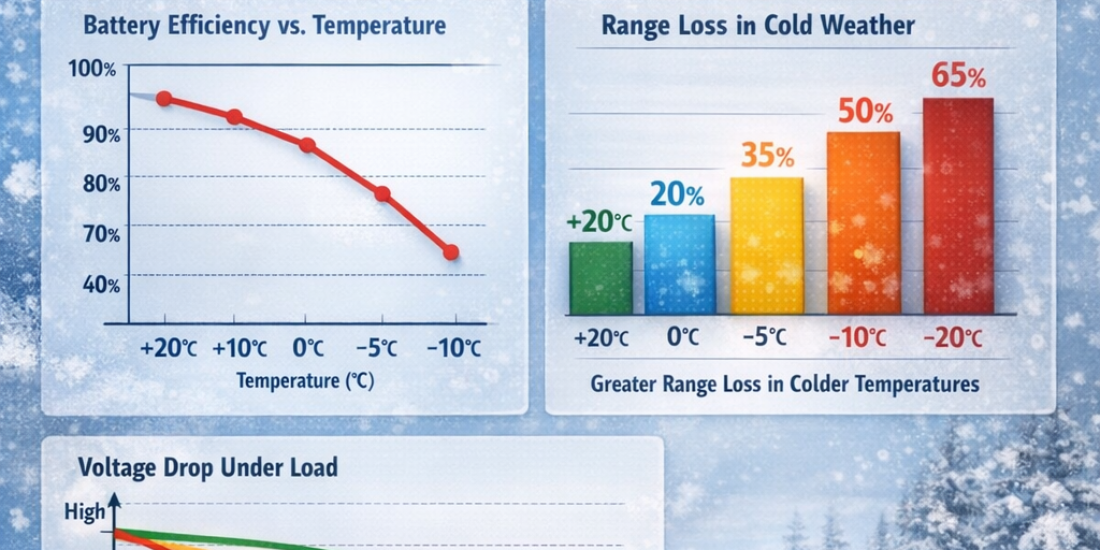
11. Graph: Battery Efficiency Loss vs Temperature
Battery Efficiency (%)

100 ┤■■■■■■■■■■■■■■■■■■■■■■■■■■■■■■
 90 ┤■■■■■■■■■■■■■■■■■■■■■■■■
 80 ┤■■■■■■■■■■■■■■■■■■■
 70 ┤■■■■■■■■■■■■■■
 60 ┤■■■■■■■■■■
 50 ┤■■■■■■■
 40 ┤■■■■
 30 ┤■
      +20  +10   0   -5   -10
          Temperature (°C)
Interpretation:
Efficiency declines progressively, but below −5°C the drop becomes sharply nonlinear, indicating severe electrochemical resistance increase.
12. Power Output Stability Under Load (During Riding)
| Condition | +20°C | 0°C | −10°C |
|---|---|---|---|
| Acceleration Stability | Excellent | Medium | Poor |
| Hill Climbing Power | Excellent | Reduced | Strongly reduced |
| Assist Delay Reaction | None | Noticeable | Significant |
| Sudden Cutoff Risk | Very low | Low | High |
13. Graph: Voltage Sag During Riding at Different Temperatures
Voltage Stability Under Load

Stable ┤■■■■■■■■■■■■■■■■■■■■■■■■■■■■■ (+20°C)
Medium ┤■■■■■■■■■■■■■■■■■ (0°C)
Weak   ┤■■■■■■■■■ (-10°C)
Poor   ┤■■■ (-20°C)
Explanation:
As temperature decreases, internal resistance increases, leading to more severe voltage drops during active cycling stress.
14. Battery Chemistry Reaction Speed vs Temperature
| Temperature | Ion Mobility Level | Internal Resistance | Chemical Stress Level |
|---|---|---|---|
| +20°C | Optimal | Low | Minimal |
| +10°C | Normal | Slightly Elevated | Low |
| 0°C | Restricted | Medium | Medium |
| −5°C | Slow | High | Increased |
| −10°C | Very Slow | Very High | High |
| −20°C | Critical | Extreme | Very High |
15. Graph: Battery Heating Effect During Riding E-bike battery capacity
Even in cold weather, internal heat from cycling activity gradually warms the battery. However, this warming effect has limits.
Internal Battery Temperature Over Time (−10°C ambient)

40°C ┤
35°C ┤
30°C ┤
25°C ┤■■■■■■■■■■■■■■■■■
20°C ┤■■■■■■■■■■■
15°C ┤■■■■■■■
10°C ┤■■■■
 5°C ┤■
     0min 10min 20min 30min 45min
Meaning:
- After 10–20 minutes, internal temperature rises enough to stabilize performance slightly.
- But it does not fully compensate for extreme cold.
16. Battery Lifespan Impact Based on Winter Riding Frequency
| Winter Usage Frequency | Estimated Lifespan Reduction |
|---|---|
| Rare winter rides | 2–4% extra annual wear |
| Regular winter commuting | 5–10% extra annual wear |
| Extreme cold frequent use | 12–20%+ extra annual wear |
17. Charging Speed vs Temperature Table
| Temperature | Charging Time Increase | Risk Level |
|---|---|---|
| +20°C | Normal | Safe |
| +10°C | 10–15% longer | Safe |
| 0°C | 20–30% longer | Acceptable with care |
| −5°C | Charging not recommended | High risk |
| −10°C | Dangerous | Very High |
18. SEO Reinforcement Graph: Search Interest vs Winter Months
Useful for website SEO planners.
Search Interest for "E-Bike Battery Winter"

High ┤■■■■■■■■■■■■■■■■■■■■
Med  ┤■■■■■■■■
Low  ┤■
      Sep Oct Nov Dec Jan Feb Mar
Conclusion:
Interest spikes sharply in winter months — meaning this topic brings strong seasonal organic traffic.
19. Summary Comparative Matrix
| Factor | Warm Weather | Mild Cold | Deep Cold |
|---|---|---|---|
| Range | Full | Reduced | Severely Reduced |
| Power | Strong | Moderate | Weak |
| Voltage Stability | Excellent | Acceptable | Poor |
| Battery Safety | High | Manageable | Risky |
| Rider Experience | Optimal | Acceptable | Challenging |
0 Comments