
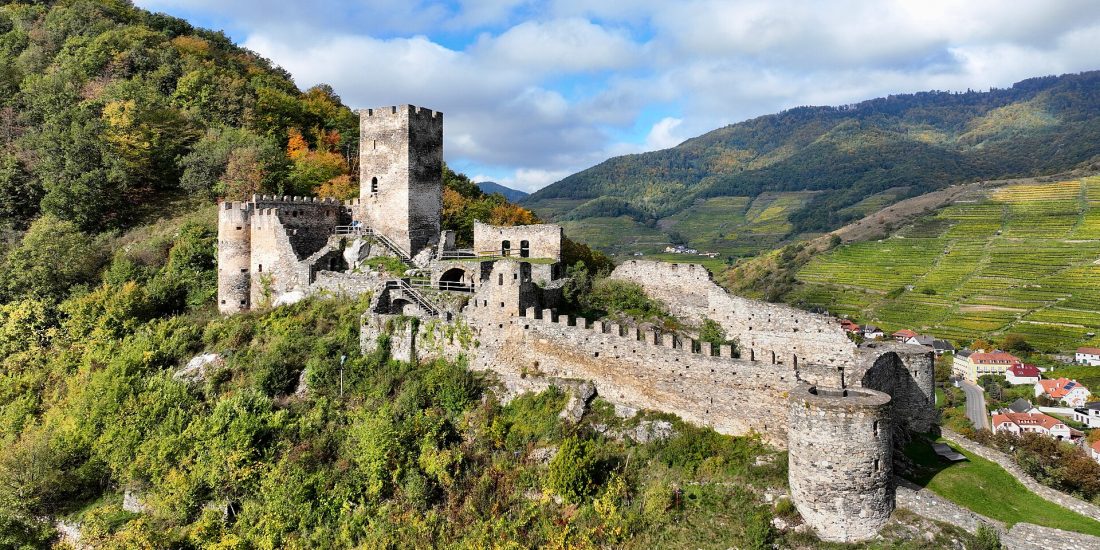
Passau to Vienna Bike Rental: How to Organise a One-Way Cycling Holiday
Route planning, seven-day stages, the bicycles to choose and the logistics of collecting in Germany and returning in Austria.DONAURADWEG · EUROVELO 6
The Danube Cycle Path is easy to follow. Getting the right bicycles to Passau, carrying your luggage and returning them in Vienna takes a little more thought. Here is how to plan the journey without turning it into a logistics exercise.
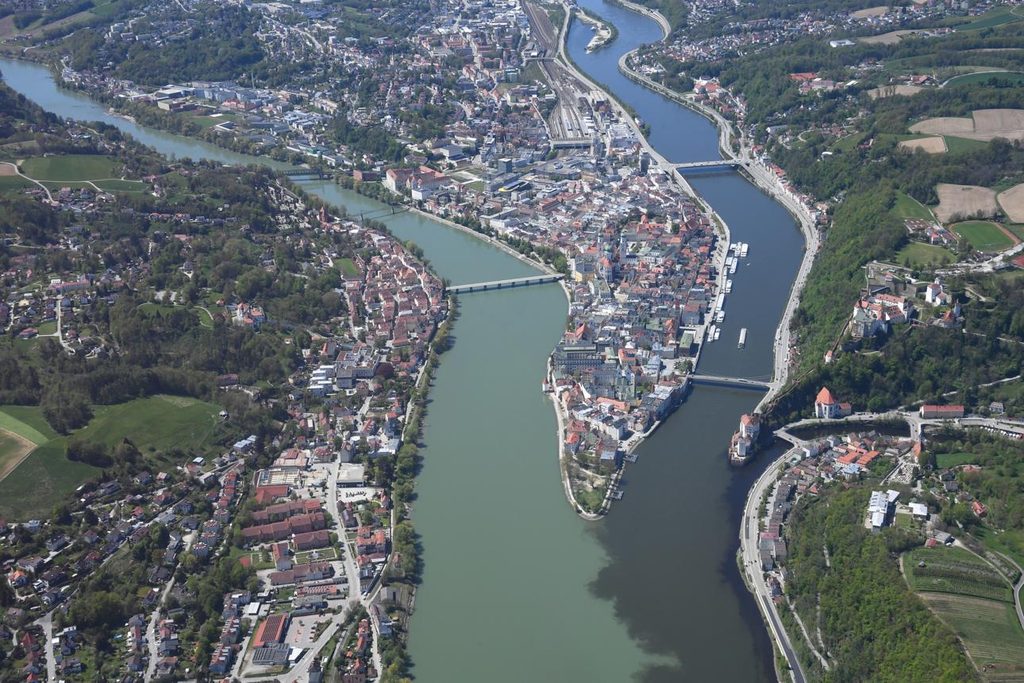
Passau, where the Inn, Danube and Ilz meet.Original photograph available on Wikimedia CommonsView photograph & sourcePassau, where the Inn, Danube and Ilz meet.© Carsten Steger · CC BY-SA 4.0
There is a satisfying moment at the start of a long-distance ride: the bags are packed, the bike feels right, and you finally stop looking at maps and begin moving. In Passau, that moment comes where three rivers meet. The Danube, Inn and Ilz flow around a compact old town, and a ribbon of cycling routes continues east towards Austria.
Roughly a week later, if you take your time, you can roll into Vienna having ridden through wooded valleys, medieval market towns, the broad river plains around Linz and one of Europe’s most celebrated wine landscapes. The riding is not particularly technical. For many visitors, the more complicated part is arranging a one-way bike rental: collecting bicycles in Germany and returning them hundreds of kilometres later in Austria.
At AustriaTrails, based near Vienna, we work with travellers who want to organise just that sort of independent journey. This guide covers the cycling, the practical arrangements and the costs worth asking about before you book.
The route in brief: how far is Passau to Vienna by bike?
The Danube Cycle Path (Donauradweg), part of EuroVelo 6, offers a mostly flat, generally well-signposted journey. Different travel companies quote approximately 300–335 km between Passau and Vienna because itineraries use different riverbanks, crossings, city approaches and occasional shortcuts. One established seven-stage itinerary totals 333 km. The exact distance on your GPS may be different. [1][2]
The surface on the classic riverside route is mainly asphalt, with some short connecting sections. This is a touring ride, not an off-road gravel expedition. A comfortable trekking bike or e-touring bike is the obvious choice for many people; a gravel bike also works very well if you like a sportier position and want the option of taking small detours away from the main path.
| At a glance | What to expect |
|---|---|
| Start / finish | Passau, Germany → Vienna, Austria |
| Distance | About 300–335 km, depending on route |
| Typical riding days | 5–7; longer if you prefer shorter days |
| Terrain | Mostly flat river valley, occasional short climbs and access ramps |
| Main surface | Predominantly paved cycle paths and quiet roads |
| Suitable bicycles | Touring, e-touring, gravel; road bikes with appropriate tyres |
| Main highlights | Passau, Schlögener Schlinge, Linz, Grein, Melk, Wachau, Krems, Vienna |
The route’s reputation for being easy is partly deserved, but easy terrain is not the same as effortless cycling. Riding 50 kilometres for six consecutive days still takes energy. Headwinds, summer heat, a full set of panniers and the temptation to stop at every historic village can make a supposedly short stage feel surprisingly long.
Where the journey becomes interesting
Passau: three rivers and the first kilometres
Before you leave, spend a little time in Passau rather than treating it as a railway station with a bicycle pickup. The historic centre sits at the meeting of the Danube, Inn and Ilz. Narrow streets climb towards the cathedral, and the different colours of the rivers are sometimes visible near their confluence. [3]
This is a sensible place to check your bicycle, adjust the saddle and pack your bags properly. Do not wait until the first hill or the first 20 kilometres to discover that your shoes are hitting the panniers, your saddle is too high or your handlebar bag blocks the cables.
A first day of around 40–55 km brings you into the Upper Austrian Danube valley towards the Schlögen area. The river soon leaves the busy surroundings behind, and the slopes become wooded and steep.
Schlögener Schlinge: the river makes two remarkable turns
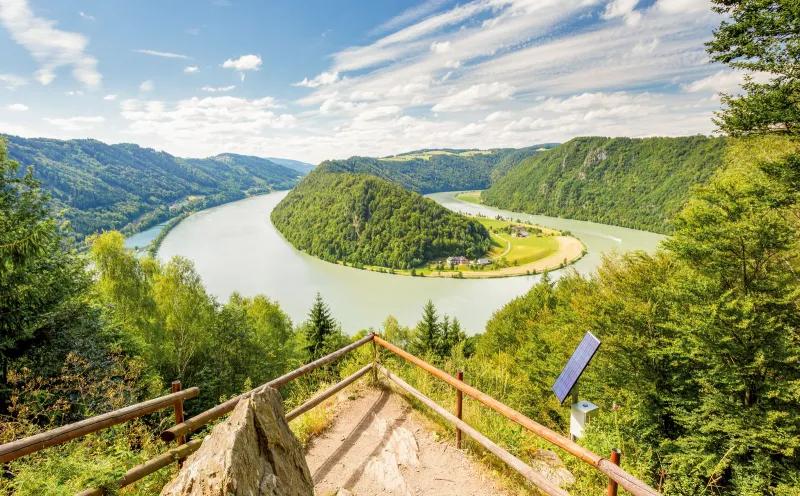
Schlögener Schlinge: a striking double bend in the Danube.Original photograph available on Wikimedia CommonsView photograph & sourceSchlögener Schlinge: a striking double bend in the Danube.© Thomas Ledl · CC BY-SA 4.0
The Schlögener Schlinge is the first landscape that many cyclists remember long after their holiday. The Danube makes a dramatic double bend between forested hills; from a viewpoint above the valley, it looks as though the river changed its mind halfway through its journey.
The best-known viewpoint is not directly on the level cycle path: reaching it involves a walk uphill. Whether you make the detour depends on your time, footwear and how much climbing you feel like doing after a day in the saddle.
There is an important practical detail, too. Not every stretch of riverbank has a continuous cycle path. Around the Schlögen loop, a riverboat transports cyclists along part of the north bank because the steep slopes interrupt the route. Services are seasonal and weather-dependent; the published 2026 season for the Donaubus ran from May to September. Check the operating dates, last departure and the exact bank of the river before relying on a crossing. [4]
Linz: a city break in the middle of the ride
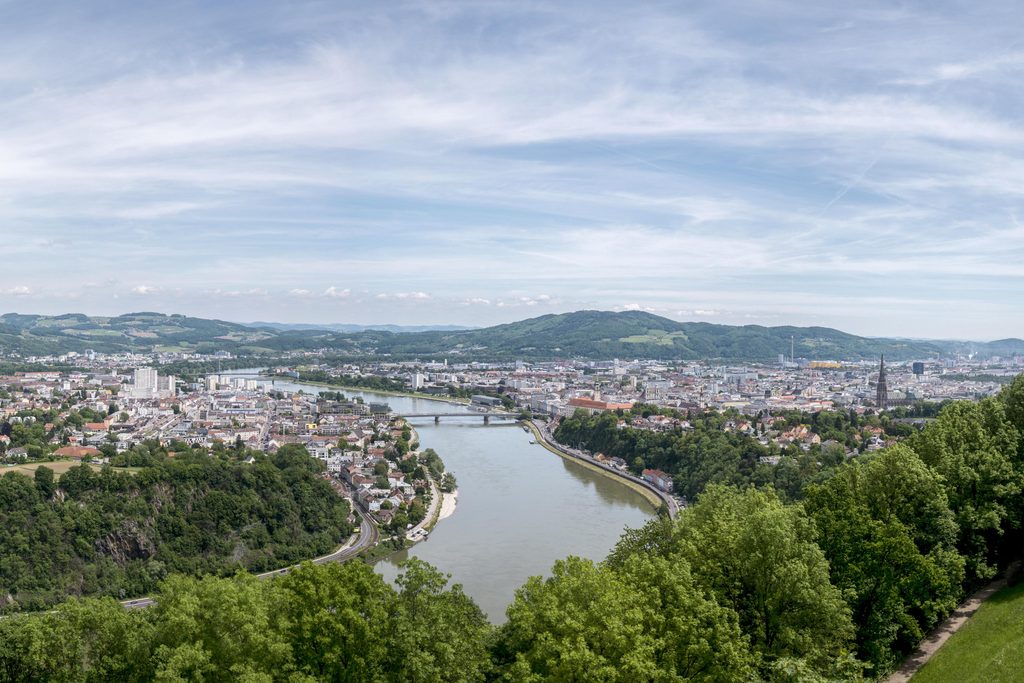
Linz provides a city break between the quiet river stages.Original photograph available on Wikimedia CommonsView photograph & sourceLinz provides a city break between the quiet river stages.© Zabia2 · CC BY-SA 3.0
Linz adds an urban interlude after the quiet Danube valley. It is worth giving the city more than a quick ride through: the broad Hauptplatz, the riverfront, the Lentos art museum and the Ars Electronica Centre show a side of Austria quite different from the castles and monasteries further downstream.
If someone in your group needs a rest day, Linz is a practical place to have it. There are bike shops, public transport options, accommodation choices and plenty to do off the bicycle.
Grein and the Strudengau: a dangerous river, long before cycle paths
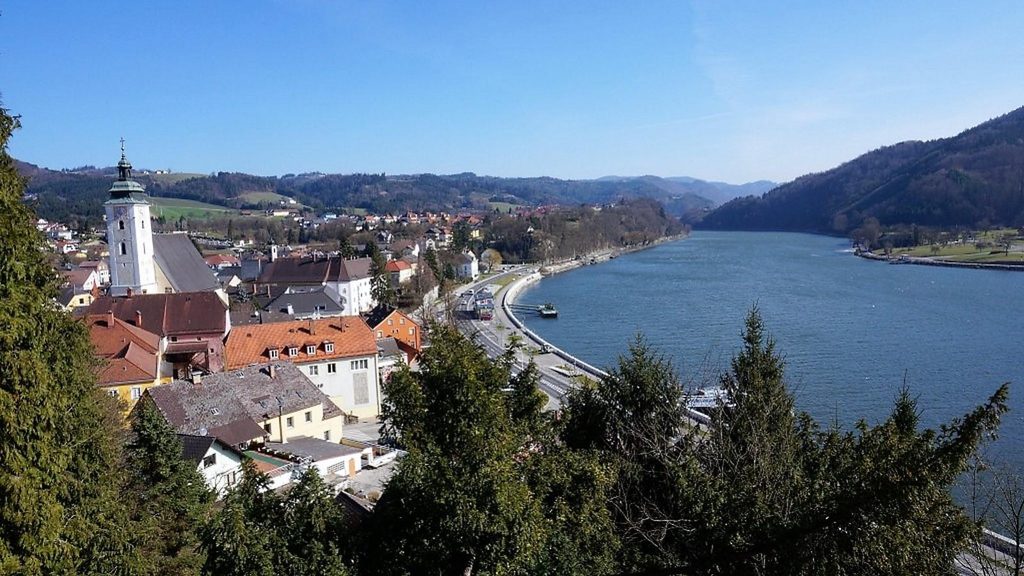
Grein, an old Danube town on the edge of the Strudengau.Original photograph available on Wikimedia CommonsView photograph & sourceGrein, an old Danube town on the edge of the Strudengau.© Piotr Tysarczyk · CC BY-SA 2.5
East of Linz, the Danube passes through towns and open countryside before the wooded slopes close in again around the Strudengau. Grein is a small riverside town with an appealing historic centre. Its setting is peaceful today, but the river here was once feared by boatmen for its dangerous currents, rocks and eddies, before river engineering and modern navigation changed the waterway.
The contrast is part of the pleasure of cycling the Danube: the route is modern, but the river’s geography still explains why towns grew where they did, where boats stopped and why certain stretches were difficult to navigate.
Melk: the abbey above the rooftops
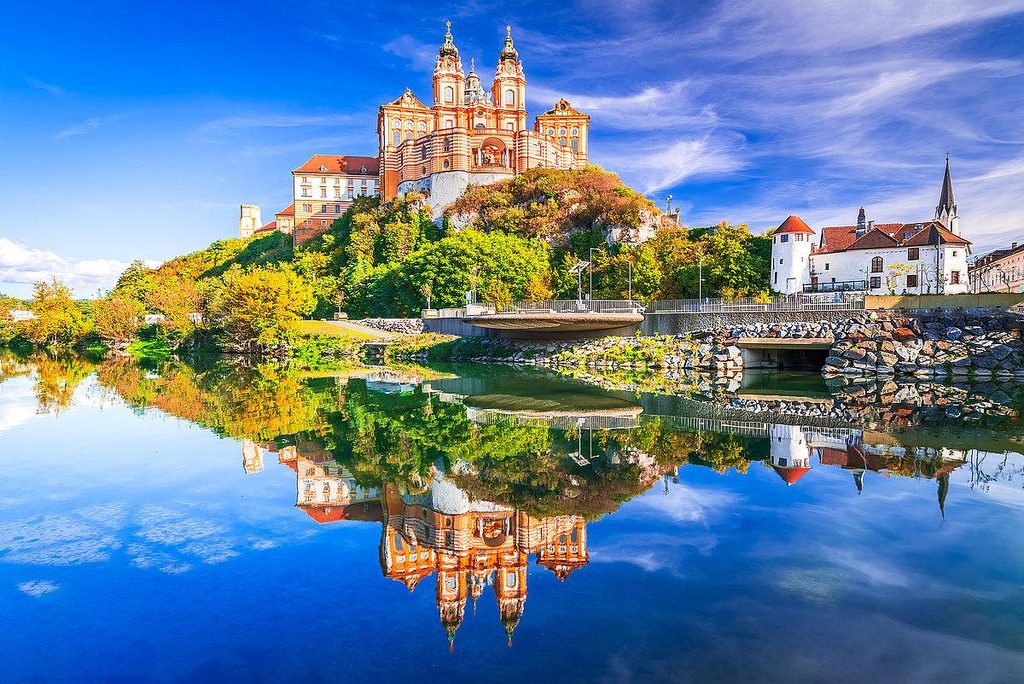
The immense Baroque abbey dominates the skyline at Melk.Original photograph available on Wikimedia CommonsView photograph & sourceThe immense Baroque abbey dominates the skyline at Melk.© Vpa248 · CC BY-SA 3.0
At Melk, the great Benedictine abbey rises over the town on a rocky ridge. Even if you do not take a full tour of its interior, it is difficult to ignore the scale of the building. It marks the western approach to the Wachau, where the character of the journey changes again.
Spend the night here if you can. An evening walk through Melk is more relaxing than trying to fit an abbey visit, lunch and another long cycling stage into the same afternoon.
Wachau: vineyards, apricots and villages worth slowing down for
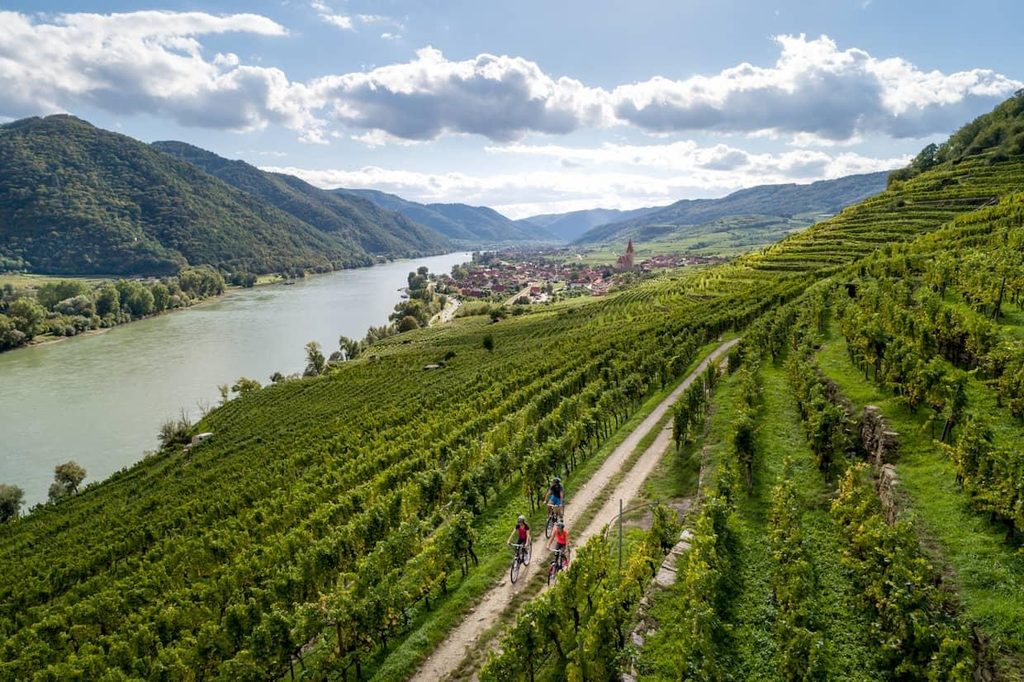
The Danube Cycle Path winds through the Wachau wine region.Original photograph available on Wikimedia CommonsView photograph & sourceThe Danube Cycle Path winds through the Wachau wine region.© Michal Klajban · CC BY-SA 4.0
The section between Melk and Krems is the part of the route that most rewards unhurried travel. The Wachau is a UNESCO-listed cultural landscape, shaped by centuries of settlement, stone-walled vineyard terraces, apricot orchards and riverside villages. UNESCO added it to the World Heritage List in 2000. [5]
You may pass through or near Spitz, Weißenkirchen, Dürnstein and Krems, depending on your chosen bank. The north-bank route includes several celebrated wine villages, but the south bank has its own character, with quieter views across the river to the terraces. Neither bank is automatically the better choice for everyone.
Dürnstein is famous for its blue-and-white abbey tower and the ruined castle above the town, associated with the captivity of the English king Richard the Lionheart in the late 12th century. It is also a place where it is easy to spend a couple of hours without noticing the time. If there is one section in which to keep your daily mileage modest, make it this one.
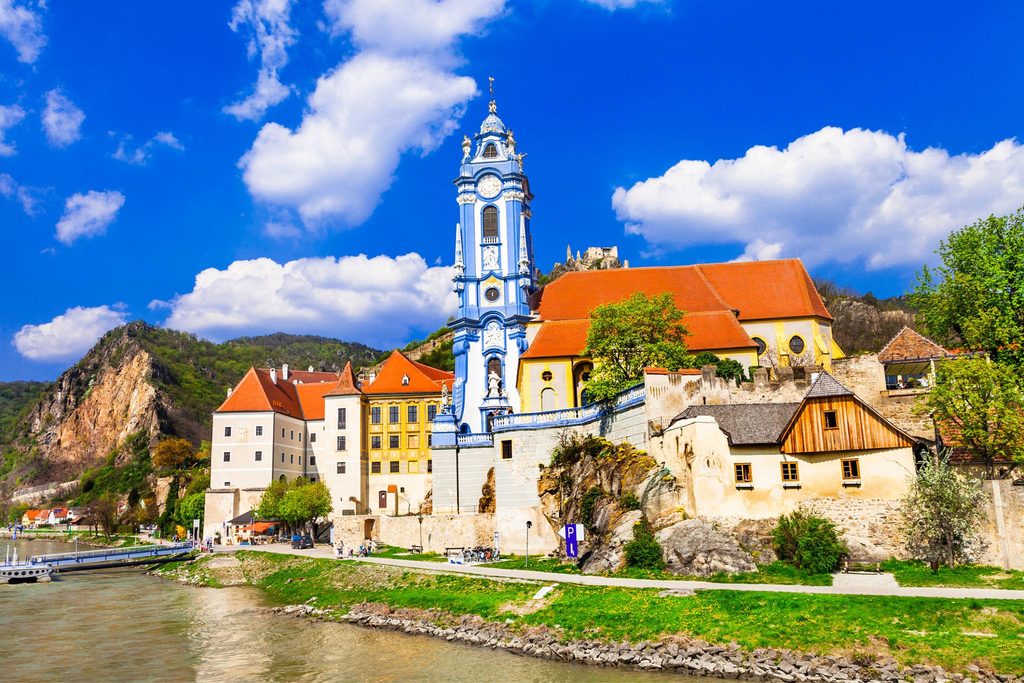
Dürnstein and the Wachau: a place to allow extra sightseeing time.Original photograph available on Wikimedia CommonsView photograph & sourceDürnstein and the Wachau: a place to allow extra sightseeing time.© Riadchikova · CC BY-SA 4.0
A practical note on wine: a glass at the end of the day’s ride is one of the pleasures of the region. Drinking before a stretch of cycling, particularly in the heat or with children in the group, is a different matter. Save the tasting for when the bicycles are parked.
Krems, Tulln and the final approach to Vienna
After Krems, the valley widens. The final days are less dramatic in places but still pleasant, passing cultivated fields, riverside woods and towns such as Tulln. The last approach brings you into a major European capital without needing to drive on a motorway or organise a car transfer for yourself.
Exactly where you finish in Vienna matters for a one-way rental. Your hotel may be some distance from the river. A sensible plan is to agree on a specific return address and time before departure rather than assuming the company can collect the bike from any location at any hour.
Seven days on the Danube: a practical itinerary
One frequently used seven-stage route is listed below. The distances are planning figures from a published itinerary, not measurements of a single GPX supplied by AustriaTrails. Changing banks, choosing different hotels or adding attractions will change your mileage. [2]
| Day | Section | Approx. distance | Why stop here |
|---|---|---|---|
| 1 | Passau → Schlögen | 43 km | A gentle introduction to the Danube valley |
| 2 | Schlögen → Linz | 57 km | Forested river bends followed by a lively city |
| 3 | Linz → Grein | 61 km | Riverside towns, open fields and the Strudengau |
| 4 | Grein → Melk | 51 km | The river valley narrows, then the great abbey appears |
| 5 | Melk → Krems | 36 km | Wachau villages, vineyards and time for sightseeing |
| 6 | Krems → Tulln | 47 km | An easier rolling day downstream |
| 7 | Tulln → Vienna | 38 km | A relaxed final stage and return of the rental bikes |
Total: approximately 333 km for this particular routing. It works well for cyclists who enjoy 40–60 km a day. For a group with less cycling experience, add an extra day in the Wachau or Linz rather than forcing everyone to keep up with the strongest rider.
Could you do Passau–Vienna in five days?
Yes, if you are comfortable with several consecutive days around 60–75 km and do not want to spend much time sightseeing. A five-day itinerary means fewer evenings in small towns and more discipline about the morning start. It is not what I would automatically recommend for first-time touring cyclists.
What about an e-bike?
An e-touring bike can make the daily distance more approachable, particularly for riders whose fitness levels differ. But an e-bike still needs regular charging, an appropriate range for the distance and terrain, and careful handling because it is heavier. Do not assume every overnight stop has a secure place to charge removable or integrated batteries. Ask your accommodation in advance.
The real question: how does one-way bike rental work?

Most bike rental websites are designed around a simple transaction: pick up a bicycle at the shop, ride it for a few days and bring it back to the same place. That works for a city holiday. It is less useful when your plan is to start in Passau, Germany, and finish in Vienna, Austria.
There are two different transport jobs behind that plan:
- Delivering the rental bikes to Passau before the tour. The bikes need to be transported safely, prepared, sized for the riders and handed over at a specific meeting point.
- Returning the bikes in Vienna after the tour. The finish location, handover time and what happens if the group is delayed should be agreed in advance.
AustriaTrails operates from Guntramsdorf, close to Vienna, and offers delivery and collection by arrangement. Its standard local delivery price advertised for Vienna-area service is not a quote for delivering bicycles all the way to Passau. Long-distance transport must be calculated separately according to the number of bikes, destination, dates and vehicle time. [6]
If you are booking a group, do not ask only for the price per bike. Ask for one complete written figure showing bike rental, accessories, Passau delivery, Vienna collection, any additional services and the payment conditions.
The handover in Passau
A good handover is boring in the best possible way. The bikes are ready; each rider confirms frame size and saddle height; luggage attachments fit; brakes and shifting have been checked; and everyone knows what to do in case of a puncture.
We recommend arranging delivery the evening before your first cycling day, where the schedule and accommodation permit. It gives you time to test the bike on a quiet street, load your bags and make adjustments without losing half the morning.
If you are arriving by train, verify your arrival time before arranging a fixed delivery slot. Train delays happen, and a group with luggage is rarely ready to ride five minutes after stepping off the platform.
Which rental bike is best for Passau–Vienna?
It depends more on riding position, luggage and daily distance than on how sporty the bicycle looks.
Touring bike or e-touring bike: the practical choice
For riders who want an upright position, easy luggage carrying and comfortable days on paved cycle paths, a trekking or e-touring bicycle makes sense. E-touring is particularly useful for mixed-ability groups, although battery charging becomes part of the daily routine.
Gravel bike: light, versatile and enjoyable
If you already ride a road or gravel bike, a gravel bicycle can be an excellent fit. The classic Danube Cycle Path is mostly paved, but gravel bikes are comfortable on small unpaved detours and can carry suitable frame bags or panniers when fitted correctly.
AustriaTrails lists several gravel models, including Focus Atlas and Cannondale Topstone, with different frame sizes and advertised daily prices that vary by model and rental period. The most important decision is not carbon versus aluminium: it is whether the frame fits you and whether your luggage setup is compatible with that particular bicycle. [7]
Road bike: for faster, lighter tours
A road bike is a possible option if you travel lightly, enjoy a lower position and intend to ride longer distances each day. It is less forgiving with large panniers, rough connectors and repeated stops if you are not used to the geometry.
What about an MTB?
A mountain bike can complete the journey, but on a predominantly paved route its tyres and riding position are not necessarily the most efficient choice. Choose it because it suits you, not because you think the word “cycle path” means an off-road trail.
Sizing and luggage: small details that make a big difference
The most common mistake in group rentals is choosing bicycles by a single label — “medium”, for example. A medium on one model may feel very different on another. Share each rider’s height, approximate inseam and preferred riding style, not just an average for the group.
For a week-long trip, pack as though you will carry every extra kilogram uphill, even if the main cycle path is flat. If you use two panniers, put heavy items low and keep the weight balanced. Test the loaded bicycle before leaving Passau.
A sensible checklist includes a helmet, lock, lights, spare tube or suitable repair kit, pump, multi-tool, rain jacket, chargers and appropriate luggage. Confirm what is included in your rental quote; do not assume that racks, panniers, pedals or bottles are automatically supplied. AustriaTrails can discuss accessories and luggage solutions depending on the model.
If you need daily luggage transfers from hotel to hotel, treat that as a separate service. A rental with Passau delivery and Vienna collection does not automatically include a support vehicle following the group or moving suitcases every day. Hotels and scheduled luggage transport also need their own booking arrangements.
How much does bike rental for a week cost?
The advertised prices on AustriaTrails vary by bike model and rental duration. For example, the Focus Atlas 6.7 gravel range currently shows €29–€39 per day on the rental page. That is a useful indication, but it is not a guaranteed quotation for a particular date or a particular one-way journey. [7]
As a purely illustrative calculation:
| Component | Example for one cyclist |
|---|---|
| Gravel bike, 7 days at €29/day | €203 |
| Optional damage cover, 7 days at €5/day | €35 |
| Luggage accessories | Quoted separately if needed |
| Long-distance delivery to Passau | Quoted separately |
| Collection in Vienna | Confirm in the transport quotation |
| Accommodation, meals, ferries and entry fees | Not included |
At the example base bike rate, four cyclists renting for seven days would pay €812 for the bicycles alone. This is arithmetic, not a package offer. Different bike choices, optional cover, transport, seasonal availability and other services change the total.
AustriaTrails’ published damage cover starts at €5 per day per bike and applies to specified minor and medium damage; it explicitly does not cover theft or catastrophic damage. A refundable deposit starting at €100 per bike per rental period is also described as an alternative. Check the current terms before making a reservation, especially for a cross-border trip. [8]
Do not confuse bike insurance with travel insurance. Lost luggage, cancellation, medical expenses and liability may require separate cover.
Is it easier to take bicycles by train instead?
Sometimes. If you already own your bicycle or pick it up in Vienna, travelling by train to Passau can be convenient. But carrying four or six bicycles, panniers and suitcases on a busy international train is a different experience from travelling with a small backpack.
ÖBB allows bicycle transport on many regional and long-distance services, but availability differs. On long-distance trains such as Railjet and ICE, a bicycle ticket and reservation are generally required; on regional trains, bike spaces are limited and cannot normally be reserved. Check the exact journey, operator and connection before you buy tickets. [9]
There is no universally correct answer. For a single rider travelling light, the train may be straightforward. For a group wanting to begin immediately in Passau, delivery of preselected rental bikes could be more practical, especially when it is arranged alongside the final collection in Vienna.
Ferries, seasons and things worth checking before departure
The Danube has two banks, but the ability to cross between them is not unlimited. Ferry operations can depend on the season, river level, weather and local schedule. Some route variants assume a ferry that may not be operating when you arrive. Before each stage, check the official route information and any notices about works, flooding or closures. [1][4]
Late spring through early autumn is a common period for touring, although conditions vary. July and August offer long days but can be hot and busy; May, June and September often provide more comfortable riding temperatures, with no guarantee of dry weather.
A few kilometres away from the river, a route can rise unexpectedly. Check proposed sightseeing detours — especially viewpoints and castles — before deciding whether they fit comfortably into the day’s plan.
Finally, remember that the route crosses from Germany into Austria. Both are in the Schengen Area, but travellers should still carry valid identity and travel documents appropriate to their nationality.
Before booking: the questions I would ask a rental company
These are the details that determine whether a one-way rental feels smooth or stressful:
- Which exact bicycle model and frame size is reserved for each rider?
- Is delivery in Passau possible on the requested date, and to which precise address?
- Does the quote include collection in Vienna, and at what location and time?
- Which accessories are included — helmet, lock, panniers, rack, pump and repair kit?
- What are the payment, deposit, damage cover and cancellation conditions?
- Who should you contact if a bike develops a mechanical problem during the ride?
- Are accommodation, luggage transfer and a support vehicle included, or arranged separately?
A clear answer to those questions matters far more than a photograph of the most expensive bicycle in the fleet.
Planning your Passau–Vienna trip with AustriaTrails

AustriaTrails is a small, independently run bike rental and workshop business based in Guntramsdorf near Vienna. Alongside local rental and guided tours, we can discuss multi-day trips requiring transport of bicycles to a different starting city, including Passau, and return arrangements at the end.
I spend a great deal of time preparing and maintaining bicycles for riders with different backgrounds. The things that matter on a week-long journey are sometimes unglamorous: reliable shifting, good brakes, correct tyre pressure, a comfortable saddle height and a luggage rack that doesn’t loosen on day three.
If you are planning a trip from Passau to Vienna, send me the dates, number of cyclists, rider heights, preferred bike types, delivery address in Passau and collection address in Vienna. I can then check what is available and put together a quotation for the rental and the logistics. Accommodation and daily luggage transport are not automatically part of that quotation.
You can browse the gravel bike rental selection, e-touring bikes and the delivery and collection information online. For a cross-border one-way journey, contacting us directly before placing the order is the most useful first step.
AustriaTrails — Guntramsdorf, Lower Austria
WhatsApp: +43 688 648 99667
Email: au***************@***il.com
The Danube will take care of the scenery. We can help you get the bicycles to the right place.
Sources and further reading
- Danube Austria — official route maps and stages
- Passau–Vienna — seven-stage itinerary (333 km)
- Passau Tourism — cycling in the three-rivers city
- Donaubus — Schlögener Schlinge ferry and seasonal operation
- UNESCO — Wachau Cultural Landscape
- AustriaTrails — bicycle delivery and collection
- AustriaTrails — gravel bike rental selection and listed daily prices
- AustriaTrails — deposit and damage cover
- ÖBB — taking a bicycle on the train
Editorial note: Route distances, ferry arrangements, rental availability and prices can change. The service examples and prices in this article were checked in November 2026.
0 Comments