
The Future of Cycling in 2035
How Technology, Artificial Intelligence and New Mobility Will Transform the Bicycle Industry
By AustriaTrails
Part 1 — The Bicycle Is About to Change More in the Next 10 Years Than It Did in the Previous 50
Introduction
For more than a century, the bicycle has remained one of humanity’s most elegant inventions. Two wheels, a lightweight frame, pedals, a chain, and handlebars have defined cycling since the late nineteenth century. While materials evolved—from steel to aluminum, titanium, and carbon fiber—and components became lighter and more precise, the bicycle itself changed gradually.
The next decade will be different.
Artificial intelligence, robotics, advanced batteries, smart materials, additive manufacturing, and connected mobility are converging at unprecedented speed. At the same time, cities are redesigning streets for bicycles, governments are investing heavily in cycling infrastructure, and consumers increasingly expect their vehicles to be connected, intelligent, and personalized.
The bicycle of 2035 will still have two wheels. But almost everything else—from the way it is designed and manufactured to how it assists, protects, and interacts with its rider—may be fundamentally different.
This article explores the technologies most likely to shape cycling over the next decade, distinguishes between confirmed industry trends and informed forecasts, and offers a vision of where bicycles may be heading by 2035.
Why Cycling Is Entering a New Era
The bicycle industry has experienced several technological revolutions.
The first was mass production, which made bicycles affordable.
The second came with lightweight aluminum and carbon fiber frames.
The third introduced suspension systems and hydraulic disc brakes.
The fourth brought electric assistance.
Today, we are entering what could become the fifth revolution: intelligent bicycles.
Unlike previous advances, this transformation is not driven by a single invention. Instead, multiple technologies are maturing simultaneously:
- artificial intelligence;
- cloud connectivity;
- advanced sensors;
- powerful electric drive systems;
- solid-state battery research;
- digital manufacturing;
- predictive maintenance;
- autonomous safety systems.
For the first time, bicycles are beginning to behave like computers on wheels.
The Biggest Trends Already Changing Cycling
Many futuristic concepts are no longer theoretical.
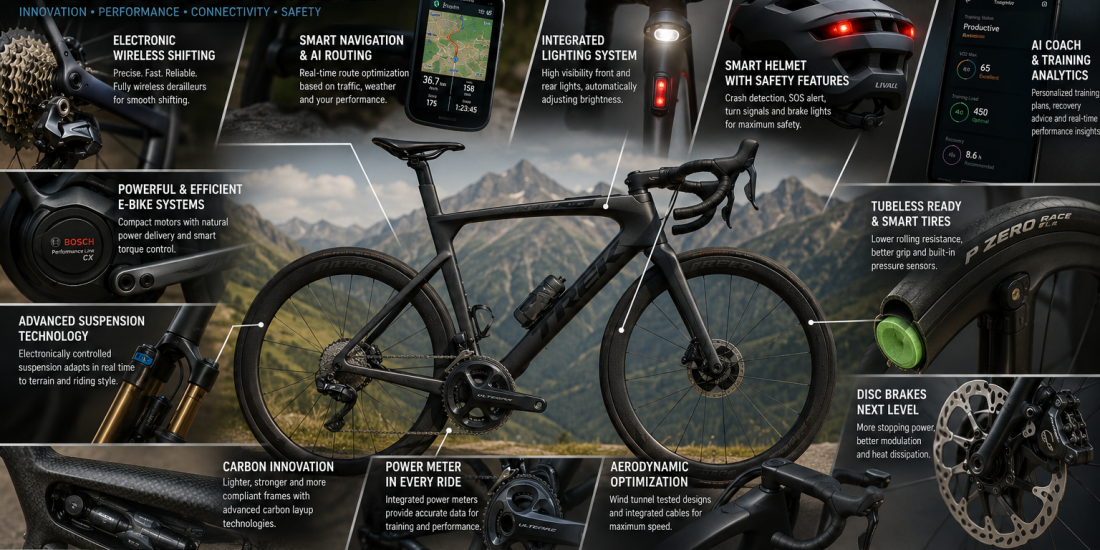
Electronic shifting, once reserved for professional racing, is steadily expanding into more product segments. Wireless drivetrains reduce cable routing, simplify assembly, and enable continuous software improvements.
Suspension manufacturers are experimenting with electronically controlled damping.
Electric bicycles have become lighter, quieter, and significantly more powerful.
Navigation systems now integrate live weather, route recommendations, and performance analytics.
Fitness data increasingly influences riding experience in real time.
The important question is no longer whether bicycles will become smarter, but how quickly.
Materials of the Future
For years, carbon fiber represented the pinnacle of bicycle engineering.
By 2035, carbon will remain important, but it may no longer dominate premium manufacturing.
Several promising directions are emerging.
Advanced Carbon Composites
Future carbon frames are expected to become more damage-resistant through improved resin systems and manufacturing methods. Small impacts that currently require professional inspection may become less critical thanks to tougher composite structures.
Manufacturers are also exploring automated carbon layup using robotic systems, improving consistency while reducing production costs.
Thermoplastic Carbon
Unlike conventional thermoset composites, thermoplastic carbon can be reheated and reshaped.
Potential advantages include:
- easier recycling;
- faster manufacturing;
- simplified repairs;
- reduced waste.
This technology could significantly improve the environmental footprint of high-end bicycles.
Graphene-Enhanced Materials
Graphene has long been promoted as a revolutionary material.
Although expectations were initially exaggerated, practical applications continue to grow.
Future bicycles may use graphene not as a primary structural material but as a reinforcement inside composite layers.
Possible benefits include:
- increased stiffness;
- improved vibration damping;
- better heat dissipation;
- greater resistance to fatigue.
Bio-Based Composites
Environmental concerns are encouraging manufacturers to investigate renewable fibers.
Flax, bamboo, hemp, and recycled carbon may become common in commuter and touring bicycles.
These materials may never replace aerospace-grade carbon in professional racing, but they could dramatically reduce manufacturing emissions.
Manufacturing Will Change Completely
Today’s bicycle factories rely heavily on manual labor.
By 2035, manufacturing could become highly automated.
Robotic carbon layup.
AI quality inspection.
Digital twins for every frame.
Automated paint systems.
3D-printed titanium lugs.
On-demand production.
Instead of warehouses filled with thousands of bicycles, manufacturers may increasingly build bicycles only after customers place orders.
Artificial Intelligence Becomes the Invisible Mechanic
The bicycle itself may remain mechanically simple.
Its intelligence, however, will increase dramatically.
Future bikes will constantly analyze:
- cadence;
- power output;
- heart rate;
- rider fatigue;
- terrain;
- wind;
- temperature;
- tire pressure;
- battery status;
- drivetrain wear.
Rather than displaying raw numbers, AI systems will interpret this information and make recommendations.
Examples:
“Shift earlier to reduce fatigue.”
“Lower tire pressure by 0.15 bar.”
“Recharge tonight for tomorrow’s planned ride.”
“Your rear brake pads have approximately 200 km remaining.”
Instead of replacing cyclists, AI will function as an experienced coach and mechanic riding alongside them.
Predictive Maintenance
One of the most practical applications of AI will be maintenance.
Today’s servicing is usually based on mileage.
Tomorrow it will be based on actual component condition.
Every ride generates valuable information:
- vibration;
- bearing resistance;
- brake temperature;
- drivetrain efficiency;
- suspension movement.
Machine-learning algorithms will detect subtle changes long before riders notice problems.
Imagine receiving a notification saying:
“Front wheel bearing expected to require replacement within the next 400 km.”
Or:
“Chain wear accelerating due to recent muddy rides.”
Unexpected mechanical failures could become significantly less common.
The Future of Electric Bikes
Electric bicycles have already transformed commuting.
By 2035, they may redefine nearly every cycling discipline.
Motors Become Smaller and Smarter
Power is no longer the main challenge.
Efficiency is.
Future motors will focus on:
- lower weight;
- quieter operation;
- smoother assistance;
- intelligent torque delivery.
Instead of fixed assistance modes, AI could continuously adjust motor behavior based on:
- rider fitness;
- road gradient;
- weather;
- battery level;
- destination.
The bike will understand not only where you are riding—but why.
Batteries
Battery technology remains one of the biggest unknowns.
Solid-state batteries are widely viewed as a promising direction, though large-scale adoption timelines remain uncertain.
If manufacturing challenges are overcome, potential benefits include:
- higher energy density;
- faster charging;
- lower fire risk;
- longer lifespan.
Even without a breakthrough, incremental improvements are likely to deliver lighter batteries with greater range over the coming decade.
Charging
Charging infrastructure will become increasingly diverse.
Possible developments include:
- wireless charging stands;
- solar-assisted charging;
- removable battery ecosystems;
- regenerative charging during long descents (useful but unlikely to replace conventional charging due to physical limits).
Gravel Bikes in 2035
No category has grown faster over the past decade than gravel.
Its flexibility perfectly matches modern cycling culture.
By 2035, gravel bikes may become even more versatile.
Possible innovations:
- electronically adjustable geometry;
- adaptive tire pressure systems;
- integrated storage compartments;
- built-in emergency lighting;
- satellite communication for remote adventures.
Rather than choosing between road and mountain bikes, many cyclists may own a single intelligent gravel platform capable of adapting to multiple environments.
Mountain Bikes Become Digital
Mountain biking will benefit enormously from intelligent systems.
Future bikes could automatically recognize terrain.
As riders enter technical descents:
- suspension stiffens or softens automatically;
- dropper post adjusts itself;
- motor response changes;
- traction algorithms optimize power delivery.
The rider remains in control—but technology quietly enhances performance.
Electronic suspension already exists in early forms today. By 2035, such systems may become far more integrated, faster, and more affordable.
Road Bikes Remain Pure—but Smarter
Road cyclists value efficiency above everything else.
Therefore, technological changes will remain subtle.
Instead of dramatic visual redesigns, future road bikes may feature:
- invisible sensors;
- integrated radar;
- aerodynamic lighting;
- predictive shifting;
- AI pacing during climbs;
- automatic nutrition reminders during long rides.
Professional racing will continue influencing consumer products, but software improvements may become as important as mechanical upgrades.
Urban Cycling Will Change the Most
The biggest transformation may occur not in sport—but in cities.
Future urban bicycles may communicate with traffic lights, navigation systems, and smart infrastructure.
Possible features include:
- automatic theft detection;
- integrated GPS recovery;
- collision prediction;
- adaptive front lighting;
- voice interaction;
- biometric unlocking.
The bicycle may increasingly become part of the broader smart-city ecosystem rather than remaining an isolated vehicle.
Cycling Safety Will Become Proactive
Most current safety technologies react after danger appears.
Future systems may attempt to predict accidents before they happen.
Examples include:
- radar detecting fast-approaching vehicles;
- AI identifying dangerous overtaking situations;
- automatic brake light activation;
- vibration warnings through handlebars;
- helmet communication systems.
Rather than replacing rider awareness, these technologies aim to provide earlier warnings and additional reaction time.
Conclusion of Part 1
The bicycle of 2035 will not abandon its mechanical roots. Pedaling, balance, efficiency, and the simple joy of riding will remain at the heart of cycling.
What will change is everything surrounding that experience.
Frames will become smarter.
Components will communicate with one another.
Maintenance will become predictive.
Electric assistance will feel more natural.
Artificial intelligence will quietly disappear into the background, helping riders without distracting them.
The next decade is unlikely to replace cyclists with technology. Instead, technology will increasingly remove friction—from maintenance and navigation to safety and personalization—allowing people to focus on what has always made cycling special: the ride itself.
The Future of Cycling in 2035
Part 2 – Artificial Intelligence, New Bicycle Categories and the Next Revolution
By AustriaTrails
The Software Era Has Begun
For decades cyclists chose bicycles almost exclusively by hardware.
Which frame?
Which suspension?
Which drivetrain?
Which brakes?
By 2035, software may become just as important as components.
Two bicycles with identical motors and batteries could offer completely different riding experiences simply because one manufacturer has developed a better AI system.
This transformation has already begun in the automotive industry. Tesla demonstrated that software updates can improve a vehicle long after purchase. The same philosophy is gradually reaching cycling.
Imagine buying a bicycle in 2030 and receiving, over the next five years, updates that improve battery management, refine shifting logic, enhance navigation, or introduce entirely new riding modes—without replacing a single mechanical component.
For the first time, bicycles may continue evolving after they leave the factory.
The Rise of the Digital Twin
Every premium bicycle may eventually have its own digital twin—a complete virtual model stored in the cloud.
This digital copy would record:
- frame serial number;
- manufacturing history;
- crash events;
- maintenance records;
- battery health;
- firmware versions;
- replaced components;
- warranty history;
- ownership history.
When selling a used bicycle, buyers could review its complete history much like service records for a modern car.
This would reduce fraud, increase resale value, and make second-hand purchases more transparent.
AI as Your Personal Coach
Cycling computers already display impressive amounts of information. The next step is turning data into advice.
Instead of saying:
“Average heart rate: 158 bpm.”
Future systems may explain:
“Your heart rate drift indicates dehydration. Reduce intensity for five minutes and drink 300 ml.”
Rather than simply measuring performance, AI could actively help improve it.
Possible coaching functions include:
- pacing long climbs;
- adjusting recovery rides;
- recommending nutrition timing;
- identifying signs of overtraining;
- adapting training plans to sleep quality and stress.
For recreational cyclists, this may prove more valuable than chasing marginal aerodynamic gains.
What Will Disappear by 2035?
Technological progress rarely adds features without replacing others.
Some familiar technologies may gradually fade.
Mechanical Shifting
Mechanical drivetrains will remain available, particularly on entry-level and touring bikes, but electronic shifting is likely to become increasingly common in the mid- and high-end segments as costs fall and reliability improves.
External Sensors
Today we attach:
- cadence sensors;
- speed sensors;
- lights;
- GPS units;
- radar;
- cameras.
Future bicycles may integrate many of these into the frame itself.
Less clutter.
Fewer batteries.
Cleaner aesthetics.
Separate Bike Computers?
Cycling computers will not necessarily disappear, but they may evolve dramatically.
Augmented reality glasses could display:
- navigation;
- speed;
- heart rate;
- power;
- traffic alerts.
Instead of looking down, riders could keep their eyes on the road.
Dedicated bike computers may remain popular for racing and endurance events, while casual riders increasingly rely on wearables or smartphones.
New Bicycle Categories
Entirely new categories may emerge.
AI Adventure Bike
Designed for multi-day expeditions.
Features:
- satellite communication;
- predictive weather routing;
- automatic battery optimization;
- emergency detection;
- integrated repair diagnostics.
Adaptive Gravel Bike
Geometry changes electronically.
Relaxed position for long rides.
Aggressive position for racing.
A single platform replacing several bicycles.
Urban Transformer
Designed for cities.
Automatically:
- locks itself;
- activates lights;
- communicates with navigation;
- adjusts riding position;
- detects theft attempts.
Family Cargo Smart
Cargo bikes become increasingly intelligent.
Future models may include:
- stability assistance at low speed;
- parking support;
- load-balancing sensors;
- child-seat monitoring.
As cargo bikes replace cars for many urban trips, safety innovations are likely to accelerate.
Explorer E-Bike
Purpose-built for long-distance touring.
Potential features:
- extremely efficient motors;
- dual-battery options;
- integrated water purification storage;
- solar charging accessories;
- emergency satellite communication.
Rather than maximizing speed, these bikes prioritize self-sufficiency and reliability.
How Major Brands Could Change
Shimano
Shimano remains one of the industry’s technology leaders.
By 2035, we may see:
- fully wireless ecosystems across more product lines;
- AI-assisted automatic shifting refined for different riding styles;
- integrated diagnostics available through smartphones;
- predictive maintenance alerts.
Shimano’s strength has always been reliability. Its future challenge will be software.
SRAM
SRAM has already embraced wireless technology.
Future developments may include:
- lighter electronic drivetrains;
- expanded automatic shifting;
- tighter integration with power meters;
- cloud-based rider profiles that synchronize between bicycles.
Bosch
Bosch helped define the modern e-bike.
The next decade will likely focus less on increasing peak power and more on improving ride quality.
Expect:
- smarter assistance;
- enhanced navigation integration;
- better battery management;
- increasingly personalized support algorithms.
DJI
DJI’s entry into the e-bike drive market surprised many observers.
Its expertise in compact motors, batteries, sensors, and software could allow it to become a significant player if it continues investing in cycling.
The company’s background in drones may encourage innovation in areas such as stabilization, sensor fusion, and intelligent control systems.
Garmin
Garmin may evolve from producing navigation devices to providing a complete cycling ecosystem.
Future products could combine:
- AI coaching;
- route optimization;
- health monitoring;
- predictive recovery;
- safety analytics.
Whether displayed on a handlebar computer, a smartwatch, or AR glasses, the underlying software could become Garmin’s greatest asset.
How Bike Workshops Will Change
The local bicycle workshop will remain important—but its role will evolve.
Mechanics will increasingly work with:
- diagnostic software;
- firmware updates;
- electronic calibration;
- battery health reports;
- cloud service records.
Instead of discovering faults after disassembly, mechanics may receive a digital report before the bicycle even arrives.
Repairs become faster.
Customers gain more accurate estimates.
Preventive servicing replaces emergency repairs.
The Future of Bike Rental
Bike rental businesses are also likely to become more digital.
Customers may reserve a bicycle that automatically adjusts:
- saddle height;
- suspension settings;
- motor assistance;
- navigation preferences;
- preferred language.
Returning customers could simply scan a QR code and find the bicycle already configured for their riding style.
For companies like AustriaTrails, this kind of personalization could significantly improve the customer experience.
Bike Tourism in 2035
Cycle tourism is expected to continue growing as infrastructure improves and electric bicycles make longer journeys accessible to more people.
Future cycling holidays may include:
- AI-generated itineraries based on fitness and interests;
- live weather rerouting;
- automatic accommodation suggestions;
- digital guidebooks;
- multilingual voice assistants;
- real-time trail condition updates.
Technology will reduce planning effort while leaving the sense of exploration intact.
Sustainability Will Become a Selling Point
Environmental performance will increasingly influence purchasing decisions.
Manufacturers may compete not only on weight and stiffness, but also on:
- recycled materials;
- repairability;
- battery recycling;
- carbon footprint;
- product longevity.
Consumers are beginning to ask not only, “How fast is this bike?” but also, “How responsibly was it made?”
Thirty Predictions for 2035
Not all of these predictions are certain, but each is grounded in current technological trends.
- AI coaching becomes standard on premium bicycles.
- Electronic shifting dominates performance bikes.
- Predictive maintenance reduces unexpected failures.
- Most e-bikes receive software updates over the air.
- Battery range continues to increase while weight decreases.
- More bicycles feature integrated radar.
- Theft recovery systems become common.
- Digital service passports replace paper records.
- Carbon recycling becomes economically viable.
- Thermoplastic composites expand into mainstream production.
- Smart helmets communicate with bicycles.
- Adaptive front lighting becomes widespread.
- Suspension settings become increasingly automated.
- Voice interaction becomes more natural.
- Gravel remains the fastest-growing sport segment.
- Cargo bikes replace many urban car trips.
- Bikepacking continues expanding globally.
- Satellite emergency communication reaches consumer bikes.
- Wearables integrate more closely with cycling systems.
- AI route planning becomes highly personalized.
- Local manufacturing increases through automation.
- 3D-printed components become more common for custom builds.
- Firmware becomes part of regular bicycle servicing.
- Used-bike values benefit from verified digital histories.
- More cycling infrastructure is built in major cities.
- Connected ecosystems become more important than individual components.
- Personalized riding profiles synchronize across multiple bicycles.
- Software subscriptions appear for advanced coaching and analytics.
- Data privacy becomes a major industry discussion.
- Cycling becomes even more accessible to older riders thanks to intelligent assistance.
Looking Beyond 2035
What happens after 2035 is even more intriguing.
Could bicycles incorporate self-healing composite materials that reduce the effects of minor impacts? Research into such materials is progressing, although practical applications for bicycle frames remain experimental.
Could shape-changing structures adjust frame characteristics on demand? Some adaptive materials and mechanical systems suggest interesting possibilities, but widespread commercial use is still speculative.
Could AI eventually anticipate hazards by combining bicycle sensors with connected infrastructure? As vehicle-to-infrastructure communication develops, such capabilities may become increasingly realistic.
History suggests that the most transformative innovations are often the ones few people predict accurately.
Final Thoughts
The bicycle has survived more than two centuries because it is remarkably efficient, simple, and enjoyable. Those qualities are unlikely to change.
What will change is the intelligence surrounding the bicycle.
The most successful bikes of 2035 may not be those with the lightest frame or the most powerful motor. Instead, they may be the ones that quietly help riders make better decisions, avoid problems before they occur, and tailor every journey to individual needs.
Technology will not replace the freedom of cycling. It will remove barriers that prevent more people from experiencing it.
Whether you ride a lightweight road bike through the Alps, explore remote gravel roads, commute across the city, or embark on a week-long bikepacking adventure, the next decade promises more choice, greater safety, and richer experiences than ever before.
One thing, however, is unlikely to change.
The greatest innovation in cycling will never be artificial intelligence, a new battery, or an advanced motor.
It will always be the simple decision to ride.
0 Comments